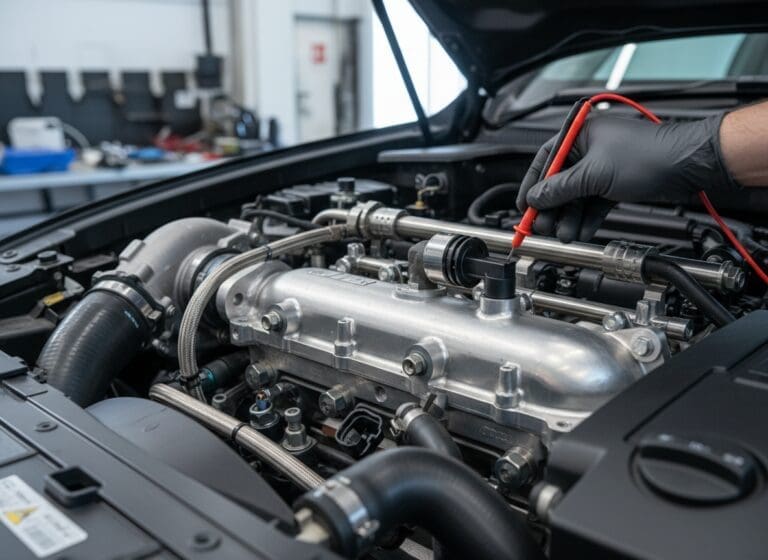

U029D usually means the ECU has lost communication with a NOx sensor module. This guide shows what causes it, what to check first, and how to fix it properly.
U029D is a network communication fault, not a “the sensor is definitely dead” message.
The most common causes are wiring/connector issues, power/ground problems, water ingress, CAN wiring faults, or a failing sensor module.
The right fix order is: confirm the comms fault, check power/ground, check the connector and loom near heat, then test CAN integrity before replacing parts.
Table of contents
- What U029D means
- Common symptoms you may notice
- Most common causes (in the real world)
- Fix steps in the right order
- When it’s wiring vs when it’s the sensor
- How to stop it coming back
- Related guides
- FAQs
What U029D means
U029D is a communication fault.
In plain terms: one module expected to “talk” to the NOx sensor module and it cannot see it on the network.
What it is
- Loss of communication with the NOx sensor module
- Usually linked to SCR/AdBlue emissions control
- Often appears with other emissions-related codes
Check power and CAN
What it is not
- Not a guaranteed “replace NOx sensor” instruction
- Not always solved by clearing codes
- Not always the same root cause every time
Diagnose first
If you treat U029D like a simple sensor failure, you can replace a good sensor and the fault returns because the comms fault never got fixed.
Common symptoms you may notice
U029D can show up with a warning light and no obvious drive issue.
Or it can trigger reduced power strategies if other emissions faults stack up.
Driver-facing symptoms
- Engine management light
- AdBlue / emissions warning message
- Occasional limp mode (varies by vehicle)
- More frequent regen attempts on some setups
- Poor MPG if the system is stuck in a fallback state
What the scanner may show
- U029D stored or pending
- Other NOx/SCR codes alongside
- NOx readings missing, stuck, or implausible
- Module “not responding” during scan
If you also have AdBlue warnings, start here:
AdBlue warning light fix |
Common AdBlue repair faults
Most common causes (in the real world)
The pattern we see most often is simple.
Heat, moisture, and vibration damage the connection long before the sensor module “dies”.
| Cause | What happens | Clue that points to it | Typical fix |
|---|---|---|---|
| Connector / pins | Loose fit, corrosion, pin push-back | Intermittent fault, worsens in wet weather | Clean, re-pin, repair connector housing |
| Wiring near exhaust heat | Insulation hardens, wire breaks inside | Fault appears after a long run or heat soak | Loom repair with proper heat protection |
| Power or ground issue | Module browns out and drops off network | U029D plus other low-voltage related glitches | Confirm supply, ground integrity, fix feed/earth |
| CAN wiring fault | Network gets noisy or open-circuit | Multiple U-codes, modules missing on scan | Network test, repair CAN high/low wiring |
| Failing NOx sensor module | Internal fault stops comms | Power/ground and wiring all test good | Replace module/sensor and code if required |
Replacing the NOx sensor without checking the connector and power/ground first.
U029D is often a “cannot see the module” issue, not “bad measurement” issue.
Fix steps in the right order
Follow this order and you cut the risk of chasing your tail.
If you book in, this is the same logic we apply before we recommend parts.
Step 1: Confirm what type of fault it is
- Read codes and note if U029D is stored, pending, or history
- Check if the NOx module appears in the module list during scan
- Look for other U-codes that suggest a wider network issue
If several modules go missing on the scan, focus on network/power supply before any single sensor.
Step 2: Check power and ground at the module
Comms faults often come from a module that is not powered properly.
A module with a weak ground can “drop off” the network under load.
- Check battery voltage health (weak batteries create odd U-codes)
- Confirm stable supply voltage at the NOx module
- Load-test the ground, not just continuity
A ground can show continuity and still fail under load. Load testing catches that.
Step 3: Inspect the connector and loom properly
- Look for water ingress, green corrosion, bent pins
- Check for pin push-back when the connector is seated
- Inspect loom routing near heat shields and exhaust sections
- Wiggle test while watching live comms status (if your tool allows)
Anywhere the loom gets hot, flexes, or rubs. That is where internal breaks happen.
Step 4: Check CAN integrity if the basics pass
If power and ground are correct and the connector looks clean, test the network side.
U029D can be a CAN high/low issue, especially if the fault is intermittent.
- Check for short-to-ground or short-to-power on CAN lines
- Check resistance and continuity end-to-end (as your platform requires)
- Confirm the module drops off only when hot or after vibration
Step 5: Only then consider module/sensor replacement
If the module has correct power/ground, clean connectors, and proven network integrity, then replacement becomes the sensible step.
Some vehicles need coding or calibration after replacement.
If you skip steps 2–4, you can fit a new sensor and still have U029D because the comms fault remained.
When it’s wiring vs when it’s the sensor
This is the decision line most people want.
Use these “tells” to point you in the right direction.
It’s more likely wiring/connector when
- The fault is intermittent
- It appears in wet weather, or after washing
- It appears after long hot runs (heat soak)
- A wiggle test changes the symptom
- There are visible signs of loom wear
It’s more likely the module when
- Power and ground are proven good under load
- CAN tests pass and other modules stay stable
- The module never responds, even briefly
- The fault returns instantly after clearing
If you have broader SCR/AdBlue symptoms too, use these pages:
AdBlue solutions |
AdBlue repair cost UK |
AdBlue pump symptoms and tests
How to stop it coming back
U029D comebacks usually happen because the repair fixed “the message”, not the stress point.
If you repair wiring, make it survive.
What makes repairs last
- Correct crimping and sealing (not twisted joins)
- Heat protection where the loom runs near exhaust
- Secure routing to stop rubbing and vibration
- Proper strain relief at the connector
What causes repeat faults
- Leaving damaged insulation in place
- Ignoring water ingress pathways
- Fixing one break while the loom is brittle elsewhere
- Clearing codes without a “prove it” road test
Related guides
- AdBlue solutions
- AdBlue repair common faults
- AdBlue pump symptoms, tests, fixes
- Check engine light guide
- AdBlue repair service
Got U029D and want it fixed properly
If your scanner shows U029D, do not guess.
We can check comms, power/ground, and loom condition, then give you the shortest route to a lasting fix.
Based in Stoke-on-Trent. Serving Stoke-on-Trent, Staffordshire, the Moorlands, and Cheshire East.
Related pages
U029D fault code FAQs
Can I clear U029D and keep driving
You can sometimes clear it, but it often returns if the module drops off the network again. If you also have AdBlue warnings or reduced power, you should diagnose it rather than ignore it.
Does U029D mean the NOx sensor is faulty
Not always. U029D means communication was lost. Wiring, connector pins, power/ground, or CAN faults can cause the same code even if the sensor itself is fine.
What causes U029D to be intermittent
Intermittent U029D often links to heat, moisture, or vibration affecting the connector or loom. Wiggle tests and heat-soak patterns are common clues.
Will a new NOx sensor fix U029D
Only if the old module is proven dead and the wiring/network tests good. If the comms fault is in the loom or connector, a new sensor can still show U029D.
Can U029D trigger AdBlue countdown or no-start
It can contribute if the SCR system cannot validate NOx readings and faults stack up. If you see countdown messages, check the wider AdBlue/SCR system rather than this code alone.