If cold-start symptoms persist alongside injector codes, it’s worth also checking for glow plug faults, which produce very similar symptoms and are often confused with injector problems without a proper diagnosis.
A practical guide to diesel injector fault symptoms — how to tell if your injectors are the problem, what fault codes appear, and what proper diagnosis and repair actually involves.
Diesel injectors are precision components that deliver fuel directly into the combustion chamber at pressures up to 2,000 bar. When they start to fail, the symptoms can be difficult to pin down because a faulty injector mimics so many other faults — rough idle, loss of power, black smoke, high fuel consumption, and check engine lights all point in multiple directions at once.
This guide explains what diesel injector fault symptoms actually look like, which fault codes to expect, how a proper diagnostic works, and what repair costs to budget for if an injector is confirmed as the problem.
How Diesel Injectors Work (And Why They Fail)
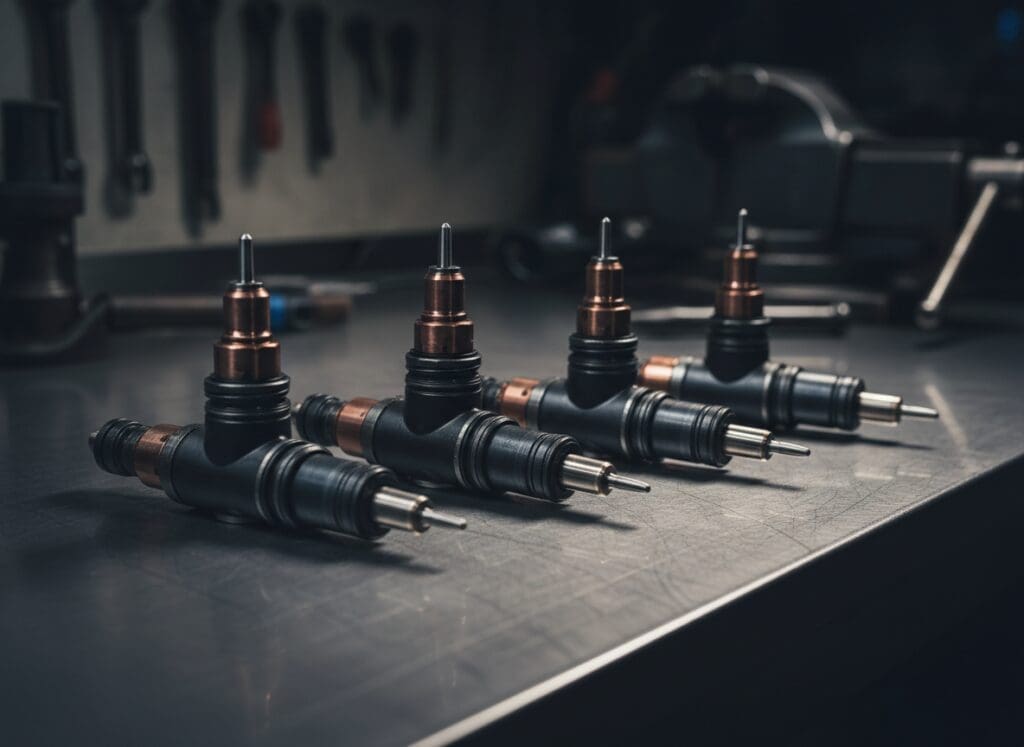
Modern common rail diesel injectors are solenoid or piezo-electric devices that open and close at extremely high speed — often multiple times per combustion cycle. The ECU commands each injector to open for a precisely calculated duration based on engine load, speed, temperature, and fuelling maps. This precision is what makes modern diesels efficient and clean.
Over time, several things cause injectors to degrade:
- Internal wear: The needle and seat inside the injector wear, reducing the seal and causing either leakage (dribbling) or restricted flow
- Carbon deposits: Build up on the injector tip and inside the spray holes, altering the spray pattern and atomisation
- Coking: Fuel residue bakes onto the injector at operating temperatures, gradually blocking spray holes
- Electrical faults: Failed solenoid coils or piezo elements that prevent the injector from opening and closing correctly
- Fuel contamination: Water or debris in the fuel system causing accelerated wear or seizure
Any of these causes a change in how fuel is delivered, which the ECU detects as a misfire, imbalance, or performance deviation — triggering fault codes and symptoms the driver notices.
Common Diesel Injector Fault Symptoms
Rough Idle and Engine Vibration
This is the most common first symptom of a failing diesel injector. When one cylinder is receiving either too much or too little fuel, the engine runs unevenly at idle. You’ll feel a lumpy, unsteady vibration through the steering wheel and body — often described as the engine “rocking” or “missing a beat.” It tends to be worse when cold and may smooth out slightly at operating temperature.
Black Smoke from the Exhaust
An injector that’s leaking or delivering too much fuel at the wrong time causes incomplete combustion. The excess unburned fuel exits through the exhaust as thick black smoke, particularly under acceleration. If you’re seeing black smoke that wasn’t there before, and it’s not clearing once the engine warms up, an injector is a serious candidate.
Loss of Power Under Load
A partially blocked injector can’t deliver the correct volume of fuel when demand is high. At light throttle on a flat road, the car may feel normal. Under load — overtaking, climbing hills, towing — the engine struggles because one or more cylinders isn’t producing full power. The characteristic feel is of the car straining rather than pulling cleanly.
High Fuel Consumption
A leaking injector (one that dribbles fuel when it should be closed) causes excess fuel delivery to that cylinder. The extra fuel doesn’t burn cleanly and reduces efficiency. Owners often notice mpg dropping 10–20% before any other symptoms appear. Combined with a slightly rougher idle, this is a reliable early warning sign.
Misfire Under Cold Start
Cold-start misfires are common with injector faults because cold fuel is more viscous and harder to atomise correctly through a partially blocked or worn injector. The engine may run on three cylinders for 30–60 seconds after a cold start before settling — often accompanied by white or grey smoke as unburned fuel vapourises from the exhaust.
Check Engine Light with Misfire Codes
A confirmed injector fault usually produces cylinder-specific misfire codes (P0300 series) or injector circuit fault codes. The check engine light may be steady or intermittent depending on how severe the fault is — but once it appears alongside a rough idle, diagnostics are essential.
Don’t confuse injector faults with EGR or DPF problems. All three can cause rough idle, black smoke, and power loss. Only a proper diagnostic with injector contribution testing will confirm which system is actually at fault.
Diesel Injector Fault Codes
| Fault Code | Description | What It Suggests |
|---|---|---|
| P0200–P0207 | Injector circuit malfunction (cylinders 1–8) | Electrical fault with injector solenoid or wiring |
| P0261–P0275 | Injector circuit low/high voltage (cylinder-specific) | Open circuit, short circuit, or failed solenoid coil |
| P0300–P0308 | Random/multiple misfire / cylinder-specific misfire | Injector not firing correctly; also possible EGR or compression fault |
| P1093 / P1094 | Fuel rail pressure low / high | Leaking injector affecting rail pressure; also high-pressure pump fault |
| P2146 / P2149 | Injector supply voltage group fault | Wiring or driver circuit fault affecting a bank of injectors |
Note on P0300 misfire codes: These don’t always mean the injector is faulty. The same code appears with glow plug faults, compression issues, and EGR problems. Injector contribution testing is the key step that separates an injector fault from other causes.
How Diesel Injectors Are Properly Diagnosed
Step 1: Read and Interpret All Fault Codes
A full system scan across all modules — not just the engine ECU — reveals the complete picture. Multiple codes logged together (injector + DPF + EGR, for example) suggest an underlying cause rather than an isolated injector failure. A technician reviews the full fault history before assuming an injector is the root cause.
Step 2: Injector Contribution Test (Cut-Out Test)
This is the most important step. Using specialist diagnostic software, the technician individually disables each injector in turn and monitors how engine speed and smoothness change. A healthy injector causes a noticeable drop in rpm and a rougher idle when cut out. A faulty injector causes little or no change — the engine barely notices it being turned off because it was already not contributing properly.
This test identifies which specific cylinder/injector is underperforming, preventing unnecessary replacement of injectors that are still working correctly.
Step 3: Injector Return Rate Measurement
Common rail injectors have a return line that routes excess fuel back to the tank. As injectors wear, the volume of fuel returned increases (called “return rate” or “back leakage”). A technician can measure the return rate from each injector individually — high return from one injector confirms internal wear and loss of sealing even if the contribution test isn’t conclusive.
Step 4: Fuel System Pressure Check
Checking that the high-pressure fuel pump is delivering correct rail pressure rules out the pump as a contributing factor. Low rail pressure caused by a leaking injector is different from low pressure caused by a failing pump — the repair path is completely different.
Diesel Injector Repair Options and Costs
Option 1: Injector Cleaning (£100–£250 per injector)
When it works: Carbon deposits or coking are restricting the spray pattern, but the injector mechanism itself is still functional.
What it involves: Professional ultrasonic cleaning and flow testing off the vehicle, or on-car cleaning using approved chemical treatments and dedicated equipment.
Best for: Injectors that are misfiring due to blocked spray holes rather than internal wear. Less effective on high-mileage injectors with mechanical wear.
Option 2: Injector Reconditioning (£150–£350 per injector)
When needed: Worn needle and seat, high return rate, but the injector body is undamaged.
What it involves: Specialist reconditioning centres strip, clean, measure, and rebuild injectors to factory tolerances. Flow-tested on a bench before return.
Best for: Single injector faults where replacement would be disproportionately expensive. Good-quality reconditioning is reliable and often comes with a warranty.
Option 3: New Injector Replacement (£250–£800 per injector)
When needed: Electrical failure, cracked body, severe wear beyond reconditioning, or manufacturer recommendation.
What it involves: Removing the faulty injector, fitting a new OEM or quality replacement, coding the new injector to the ECU (essential on modern common rail systems), and rechecking fuel system performance.
Important: New injectors on modern diesel engines must be coded to the ECU. Each injector has a calibration code (IMA code on Bosch systems, C2I code on Delphi) that tells the ECU how to compensate for that specific injector’s flow characteristics. Fitting an injector without coding it causes poor running and incorrect fuelling.
What Does It Cost to Replace All Four Injectors?
If multiple injectors are confirmed faulty, replacing the full set makes economic sense — you save labour by doing them all at once rather than returning later for a second and third. A full set of four remanufactured injectors for a common 2.0 TDI engine typically costs £800–£1,400 including coding and labour. OEM new injectors run £1,500–£2,500 for a set of four.
Preventing Diesel Injector Problems
Use Quality Diesel Fuel
Budget supermarket diesel contains fewer detergent additives than branded premium fuel (Shell V-Power, BP Ultimate). These detergents help keep injector tips clean and prevent coking. If you drive mostly on budget fuel, adding a quality injector cleaner treatment every 5,000–10,000 miles helps maintain injector cleanliness.
Don’t Run the Tank Below a Quarter
Running low on diesel draws fuel from the bottom of the tank where sediment and water accumulate. This debris reaches the injectors and accelerates wear. Keep the tank above a quarter at all times — especially on older vehicles whose tanks may have accumulated years of sediment.
Change the Fuel Filter on Schedule
The diesel fuel filter protects the injectors from contaminants. A blocked or degraded filter allows fine particles to reach the injectors. Follow the manufacturer’s service interval — typically every 20,000–30,000 miles — and use a quality replacement filter rather than the cheapest available.
Service Intervals Matter
Regular oil changes reduce engine blow-by (combustion gases entering the crankcase), which reduces carbon deposits throughout the fuel system. Engines that are regularly serviced with quality oil show significantly lower injector coke deposits at high mileage.
Frequently Asked Questions
Can a diesel injector fault cause the DPF to block?
Yes. A leaking or misfiring injector causes incomplete combustion, producing extra soot. This soot loads the DPF faster than normal, potentially triggering DPF warning lights and preventing passive regeneration. Fixing the injector fault first is essential before addressing DPF issues — otherwise the DPF will just block again.
Can I drive with a faulty diesel injector?
Short distances, yes — but the risks accumulate quickly. A leaking injector can wash oil off the cylinder walls (oil dilution), damaging the piston and bore. An over-fuelling injector can hydrolock the engine if enough raw fuel accumulates in the cylinder. Get it diagnosed promptly rather than hoping it resolves itself.
Do I need to replace all injectors at once?
Not necessarily — if only one injector is faulty by contribution testing and return rate measurement, replacing that one is the right approach. However, if the vehicle is high-mileage (120,000+ miles) and one injector has failed, the others are often not far behind. A technician can advise based on the return rate data from each injector.
How long does injector replacement take?
A single injector replacement typically takes 2–4 hours depending on the vehicle and injector access. Full sets of four take 4–6 hours. Injectors that have been in place for a long time on high-mileage vehicles sometimes seize into the cylinder head, adding removal time — and occasionally requiring specialist extraction tools.
What’s the difference between a solenoid and piezo injector?
Solenoid injectors use an electromagnetic coil to open and close. They’re common on many Ford, Vauxhall, and Renault diesel engines and are generally more affordable to replace. Piezo injectors (common on VAG, BMW, and some Bosch applications) use a piezo-electric element for much faster, more precise actuation. They’re more expensive to replace but offer better fuel economy and emissions on the vehicles that use them.
Will engine carbon cleaning help faulty injectors?
Carbon cleaning (hydrogen or walnut blasting) removes deposits from intake valves and combustion chambers, which can help a lightly coked injector. However, it won’t fix a mechanically worn injector, an injector with a faulty solenoid, or one with severe internal scoring. It’s a useful maintenance service but not a substitute for injector diagnostics.
Suspected Injector Fault? Get It Confirmed Properly
Injector symptoms overlap with EGR, DPF, and turbo problems. Our contribution testing and return rate measurement pinpoint the exact injector at fault before anything is replaced. Based in Stoke-on-Trent — serving Staffordshire and surrounding areas.


