
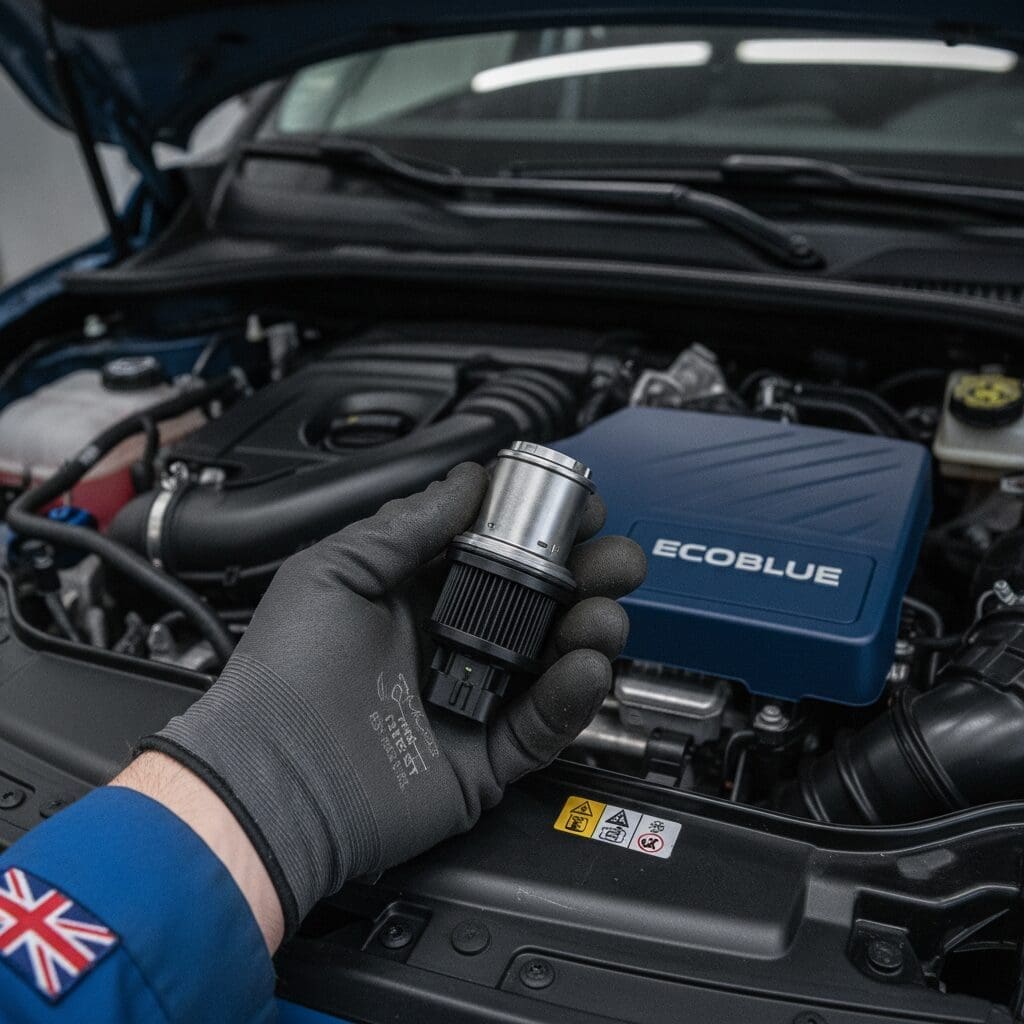
Everything UK drivers need to know about mass air flow sensor faults — from first symptoms to replacement cost
What Is a MAF Sensor and What Does It Do?
The Mass Air Flow (MAF) sensor — sometimes called the air mass meter — measures the volume and density of air entering the engine’s intake. This information is sent to the ECU, which uses it to calculate the correct fuel delivery for any given driving condition. It is one of the most important inputs the engine management system relies on.
On modern petrol and diesel engines, the MAF sensor is typically a hot-wire type mounted in the intake air duct between the air filter and the throttle body or inlet manifold. A fine wire element is electrically heated, and the ECU measures how much current is needed to maintain that temperature as air flows past it. The higher the airflow, the more cooling effect — and the more current required. This gives the ECU a precise picture of how hard the engine is working at any given moment.
Without accurate MAF sensor data, the engine cannot run the correct air-to-fuel ratio. This affects fuel economy, power delivery, emissions, and the longevity of components including the DPF and catalytic converter.
Quick answer: MAF sensor replacement in the UK typically costs £80 to £250 for the part, plus 30 to 60 minutes of labour. Total bills of £120 to £350 are common depending on the vehicle make. Diagnosis should always come first — a faulty MAF can mimic several other faults.

Symptoms of a Failing MAF Sensor
MAF sensor faults rarely produce a single obvious symptom. More often, they cause a cluster of performance and economy problems that can be easy to misdiagnose. Here are the most common signs:
Engine Warning Light (MIL)
The engine management light is one of the first indicators. Common MAF-related fault codes include P0100, P0101, P0102, P0103, and P0104. These relate to MAF circuit faults or signal range issues. An OBD scan is essential to confirm the code before replacing any parts.
Poor Fuel Economy
If the MAF sensor is reading low (reporting less air than is actually entering), the ECU will run a lean mixture. If it reads high, the mixture goes rich. In both cases, fuel economy drops noticeably — typically by 10 to 20 percent on a vehicle with a significantly degraded sensor.
Rough Idle or Hesitation
A MAF sensor that is intermittently faulty or contaminated often produces a rough or hunting idle. You may notice the engine feeling unsteady at junctions or in traffic, with occasional surging or stuttering when pulling away.
Loss of Power or Flat Spots
Incorrect air mass readings directly affect how the ECU calculates injector pulse width and ignition timing. The result is often a noticeable flat spot when accelerating, or a general feeling that the car lacks the power it should have — particularly under load at motorway speeds.
Black Smoke or Rich Running (Diesel)
On diesel engines, a MAF sensor that underreports airflow can cause the ECU to over-fuel, leading to visible black smoke from the exhaust and a smell of unburned fuel. This also accelerates DPF loading and can lead to premature DPF blockage.
Difficulty Starting
In severe cases, a failed MAF sensor can cause difficult or extended starting — particularly on cold mornings. The ECU struggles to calculate the correct cranking enrichment without accurate airflow data.
Don’t guess: MAF sensor symptoms overlap with faulty lambda sensors, fuel pressure issues, intake leaks, and clogged injectors. Always confirm with a diagnostic scan before replacing any parts.
MAF Sensor Fault Codes
When a MAF sensor fault is present, one or more of the following codes will typically store in the ECU. These are the most commonly seen:
| Code | Description | Common Cause |
|---|---|---|
| P0100 | MAF Circuit Malfunction | Open or short circuit in MAF wiring |
| P0101 | MAF Circuit Range/Performance | Contaminated or degraded MAF element |
| P0102 | MAF Circuit Low Input | Sensor reading too low — wiring or sensor fault |
| P0103 | MAF Circuit High Input | Sensor reading too high — sensor or ECU fault |
| P0104 | MAF Circuit Intermittent | Loose connection, damaged wiring loom |
Some vehicles also produce manufacturer-specific codes alongside these generic ones. Reading freeze frame data alongside the fault code helps confirm whether the fault is active or intermittent, which affects how you approach the repair.

MAF Sensor Cleaning vs Replacement: Which Do You Need?
MAF sensor cleaner sprays are widely available and can be effective if the sensor’s wire element is simply contaminated with oil vapour, dust, or intake deposit residue. This is particularly common on vehicles with oil-wetted performance air filters, where filter oil can deposit on the sensor wire.
Cleaning is worth trying if:
- The fault code is P0101 (range/performance) rather than a circuit fault
- The vehicle has a performance air filter or has recently had the air filter changed
- The symptom is a mild loss of economy rather than a complete fault
- The sensor is relatively new (under 60,000 miles)
Replacement is the right call if:
- Cleaning has been attempted and the fault has returned within a short period
- The fault code indicates a circuit fault (P0100, P0102, P0103) rather than just performance
- Live data shows the sensor is giving obviously incorrect readings compared to a reference value
- The vehicle has over 80,000 miles and has never had the MAF replaced
- There is visible damage to the sensor element or connector
Always check the intake for leaks first. An air leak between the MAF sensor and the throttle body will cause exactly the same symptoms as a faulty MAF, because unmetered air is entering the engine. Before replacing the sensor, a smoke test or careful visual inspection of intake hoses and joints should be carried out.
MAF Sensor Replacement Cost UK 2026
The cost varies depending on the vehicle make, whether you use an OEM or aftermarket part, and whether you are having the work done at a main dealer or an independent specialist. Here is a realistic breakdown:
Aftermarket MAF Sensor (Part Only)
£40 to £120 for most common vehicles including Ford, Vauxhall, VW, Audi, and BMW. Quality aftermarket sensors from Bosch, Delphi, or Denso are reliable alternatives to OEM and are typically what independent specialists fit.
OEM/Dealer MAF Sensor (Part Only)
£80 to £250+ depending on the vehicle. BMW, Mercedes, and Volkswagen Group vehicles tend to carry higher OEM part prices. For most vehicles, a quality aftermarket sensor from a recognised brand performs identically.
Labour (Independent Specialist)
30 to 60 minutes of labour at typical independent rates (£60 to £80 per hour), bringing total labour to £30 to £80. MAF sensor access is straightforward on most vehicles.
Total Typical Cost
£120 to £250 at a good independent specialist for most petrol and diesel cars. Main dealer prices typically run £50 to £150 higher for the same repair.
Diagnostics: A proper diagnostic scan and live data check before replacement costs around £40 to £80 at an independent specialist. This is money well spent — misdiagnosed MAF replacements are common, and an intake leak or lambda sensor issue can produce identical symptoms.
What Happens If You Ignore a Faulty MAF Sensor?
A MAF sensor fault is not the kind of thing that resolves itself. Left unaddressed, a faulty sensor causes increasingly serious knock-on problems:
- DPF damage: On diesels, incorrect fuelling causes excessive soot production and accelerated DPF loading. A DPF replacement costs £1,000 to £3,000 — far more than a MAF sensor repair.
- Catalytic converter damage: Rich running from a faulty MAF can overheat and damage the catalytic converter.
- Injector wear: Prolonged rich fuelling increases carbon deposits on injector tips and combustion chamber surfaces.
- MOT failure: An active engine management fault causes an automatic MOT failure on the vehicle health check, regardless of whether emissions are visibly affected.
- Fuel costs: A 10 to 20 percent fuel economy drop is real money — on a vehicle doing 15,000 miles per year at average UK diesel prices, this represents an additional £200 to £400 per year in fuel costs.
MAF Sensor Fault? Get It Diagnosed Properly
At Pro Remapping in Stoke-on-Trent, we diagnose MAF sensor faults correctly before any parts are changed. Using live data alongside fault codes, we confirm whether the sensor is genuinely at fault, check for intake leaks, and verify the repair is complete before the car leaves. We work on all makes and models including Ford, BMW, Vauxhall, Volkswagen, Mercedes, and more.
All Makes & Models
Live Data Analysis
Stoke-on-Trent
Staffordshire
Frequently Asked Questions
Can I drive with a faulty MAF sensor?
In most cases yes, but it is not recommended for any length of time. A faulty MAF sensor causes poor fuel economy, increased emissions, and — on diesel cars — accelerated DPF loading. If the car is running noticeably rough or misfiring, it should not be driven until the fault is diagnosed. An active engine management light will also cause an MOT failure.
Will cleaning the MAF sensor fix my problem?
It can do, particularly if the fault code is P0101 and the sensor is contaminated rather than failed. Use dedicated MAF sensor cleaner, not general electrical contact cleaner, and allow it to dry completely before refitting. If the fault returns within a few hundred miles after cleaning, replacement is the next step.
How do I know if it’s the MAF or a different sensor?
The fault code tells you where the fault is registering, but not always what caused it. Reading live data is the key — a correctly operating MAF sensor on a 2.0 diesel should read approximately 350 to 600 mg/stroke at idle and climb proportionally with engine load. A reading that is fixed, implausibly low, or erratic points to a sensor problem. If the reading looks correct but fuelling is still off, an upstream air leak or lambda sensor fault may be the real cause.
Is an aftermarket MAF sensor as good as OEM?
For most vehicles, yes — provided you use a branded quality part from Bosch, Delphi, Denso, or another tier-1 supplier. Cheap unbranded sensors from online marketplaces can cause ongoing issues. Always check the part fits the exact vehicle and engine variant, as MAF sensors are not universal.
Will a new MAF sensor need to be programmed or coded?
In most cases, no. MAF sensors are plug-and-play on the vast majority of petrol and diesel vehicles. Some vehicles require the fault codes to be cleared and an adaptation reset performed after replacement, but this is handled with a diagnostic scanner rather than specialist programming.


