
AdBlue Pump Failure: Symptoms, Replacement Cost UK & What to Do Next
Your AdBlue pump is the heart of the SCR system — when it fails, the whole system stops working. Here’s what the symptoms look like, what replacement costs in the UK, and when it’s worth fixing versus deleting.
Quick Answer
AdBlue pump failure typically triggers fault codes P20BA, P205B or P2068, causes recurring AdBlue system warnings, and can lead to engine start lockout. UK replacement cost is typically £300–£800 fitted. If your pump has already failed once, or if your vehicle is high mileage, a permanent AdBlue delete is often the more cost-effective long-term solution. Pro Remapping covers both options across Stoke-on-Trent and Staffordshire.
What Does the AdBlue Pump Actually Do?
The AdBlue dosing pump — sometimes called the SCR pump or DEF pump — is the component responsible for drawing AdBlue fluid from the tank and delivering it under pressure to the AdBlue injector. The injector then sprays a fine mist of AdBlue into the exhaust stream upstream of the SCR catalyst.
When AdBlue mixes with the hot exhaust gases, it reacts with NOx to produce nitrogen and water — harmless byproducts. This is how modern Euro 6 diesels meet emissions standards. Without a functioning pump, no AdBlue reaches the catalyst, the NOx conversion drops, and the ECU detects the failure.
Symptoms of a Failing or Failed AdBlue Pump
AdBlue pump failure has a fairly distinctive symptom pattern that separates it from simple low-fluid warnings. Here’s what to look for:
AdBlue Warning Light After a Recent Top-Up
This is the most telling symptom. If you’ve just topped up your AdBlue tank and the warning light comes back on within days — or never clears after topping up — the pump is a likely culprit. The system needs the pump to confirm that fluid is being dosed correctly. If it can’t detect dosing activity, it assumes the system has failed.
Persistent “AdBlue System Fault” Message
Unlike a low-fluid warning, an “AdBlue system fault” or “emissions system fault” message points to a component failure. The pump is one of the first components to trigger this message when it fails. Clearing the code with a scanner will reset the warning temporarily, but it will return within a short drive if the pump is at fault.
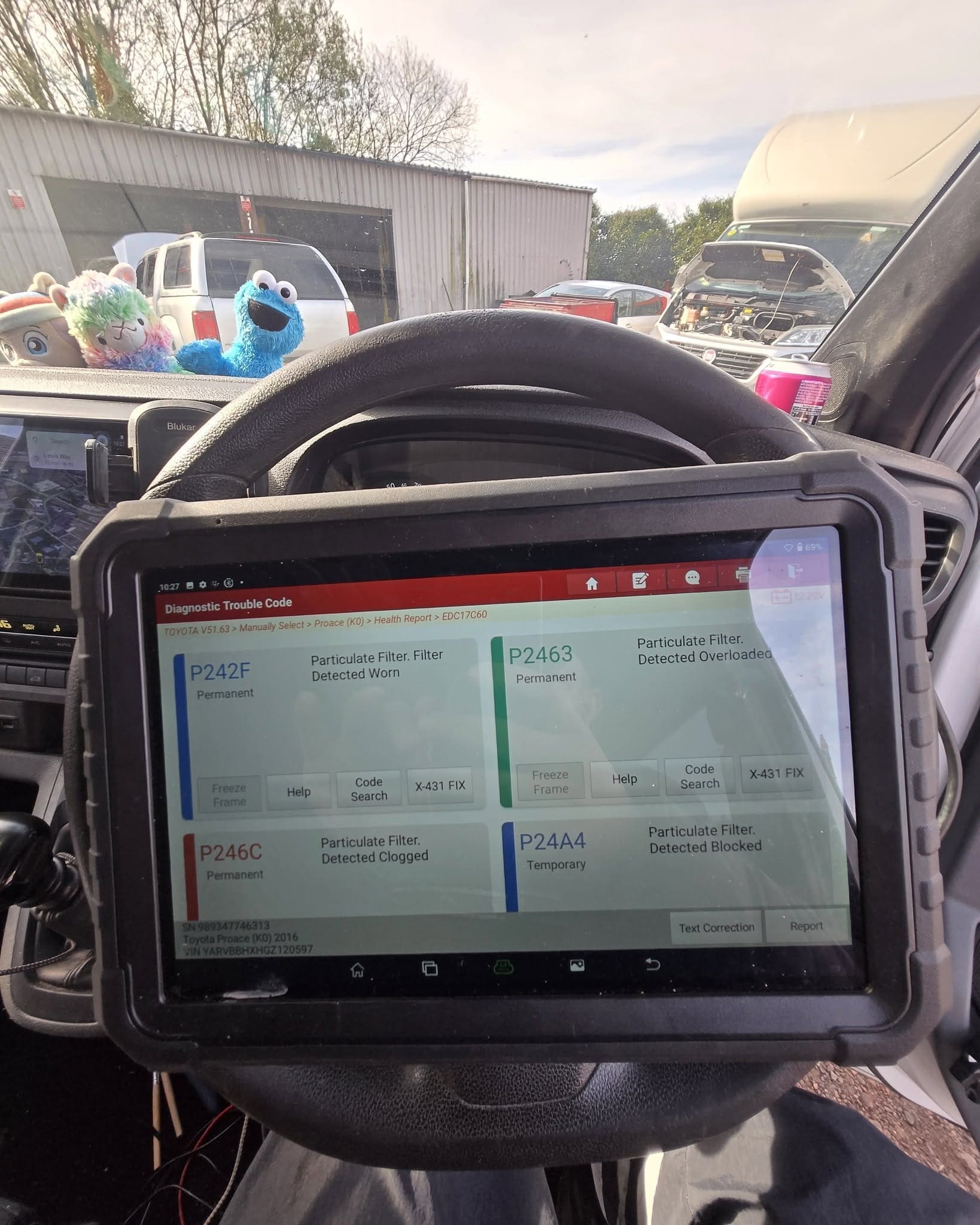
Fault Codes P20BA, P205B, P2068
These codes are directly associated with the AdBlue dosing system:
- P20BA — Reductant Pump Control Circuit Performance: The pump circuit is not responding as expected
- P205B — Reductant Pump Control Module Performance: The pump module itself is failing
- P205C — Reductant Pump Control Module Supply Voltage Low: Power delivery to the pump is insufficient
- P2068 — Reductant Injector Control Circuit: May appear alongside pump codes if the injector is also affected
Engine Start Countdown Activating
If the pump fails and the ECU cannot confirm AdBlue delivery, it may initiate the countdown to engine start lockout — even if the tank is full. This is because the system cannot verify the fluid is being used. The countdown is based on fault cycles, not just fluid level.
No AdBlue Consumption Over Time
If you notice that your AdBlue tank level hasn’t dropped at all despite covering thousands of miles, the pump may have failed silently. Normal AdBlue consumption is roughly 1 litre per 500–600 miles of mixed driving. No consumption means no dosing.
AdBlue Pump Replacement Cost UK: What to Expect
The cost of AdBlue pump replacement in the UK varies depending on the vehicle, the pump specification, and the labour time required to access and replace it. Here’s a realistic breakdown:
| Cost Element | Typical Range | Notes |
|---|---|---|
| AdBlue pump (OEM) | £200–£500 | Genuine parts, from dealer or approved supplier |
| AdBlue pump (aftermarket) | £80–£250 | Quality varies significantly — beware cheap alternatives |
| Labour | £80–£250 | Access difficulty varies greatly by model |
| Diagnostic scan | £50–£80 | Needed to confirm pump is the root cause |
| Total (typical) | £300–£800 | OEM part, fitted, diagnosis included |
Higher costs apply to vehicles where the pump is in a difficult location — Land Rover Discovery and some Mercedes Sprinter variants can be at the upper end of the labour scale. Dealer prices will generally be higher than independent specialists.
Which Vehicles Are Most Prone to AdBlue Pump Failure?
AdBlue pumps across most Euro 6 diesel models are reasonably reliable under normal conditions. However, certain vehicles and use cases see higher failure rates:
High Failure Rate Vehicles
- Land Rover Discovery 5 (underfloor pump exposure)
- Ford Transit Custom SID212Evo
- Mercedes Sprinter W907
- Vauxhall Vivaro / Renault Trafic (Bosch pump modules)
- BMW 5 Series / 7 Series diesel
Risk Factors
- Off-road use (moisture/mud ingress)
- Very cold climates (fluid freezing)
- Extended periods of inactivity
- Running the tank completely dry repeatedly
- High mileage (150,000+ miles)
Van operators and fleet owners tend to experience more pump failures than private car owners, simply because of higher annual mileage and less regular maintenance attention.
AdBlue Pump Repair or Delete: Which Makes More Sense?
This is the question most owners ask after they’ve been quoted for pump replacement. The answer depends on several factors:
When Pump Replacement Makes Sense
If your vehicle is relatively low mileage, the pump is the only component that has failed, and the rest of the SCR system is in good condition, repair is usually the right call. A replaced pump should give several more years of reliable service if the rest of the system is healthy.
When an AdBlue Delete Makes More Sense
If the pump has already been replaced once, or if diagnostic work shows multiple failing components (pump plus NOx sensor, or pump plus catalyst), the cost of full repair can easily exceed £1,500–£2,000. At that point, a permanent AdBlue delete removes the entire system from the ECU — eliminating all related faults, warnings, and future component costs in one step.
An AdBlue delete is also the preferred route for fleet operators who cannot afford vehicle downtime or the risk of unexpected lockouts. One-time cost, no ongoing AdBlue fluid cost, no more scheduling top-ups.
Before deciding, read our guide to AdBlue delete legality in the UK and our breakdown of AdBlue repair costs to understand the full picture.
What Happens If You Don’t Replace a Failed AdBlue Pump?
Driving with a confirmed pump failure is not straightforward to ignore. Here’s what happens over time:
- The ECU logs repeated fault cycles and escalates the fault status
- The no-restart countdown activates based on fault cycles — not just mileage
- Once the counter reaches zero, the engine will not restart after being switched off
- Recovery, diagnosis, and repair at that point will cost more than acting early
- Emissions testing at MOT will likely result in a fail
The practical reality is that a failed AdBlue pump is not a fault you can defer indefinitely. Either repair it or resolve it permanently — leaving it causes escalating problems.
AdBlue Pump Fault? Get It Diagnosed Today
Pro Remapping in Stoke-on-Trent diagnoses and resolves AdBlue pump faults across the full range of Euro 6 diesel vehicles — cars, vans, and commercial vehicles. We’ll tell you honestly whether repair or delete is the better option for your specific situation.
Frequently Asked Questions
Can I drive with a failed AdBlue pump?
Short distances, yes — but the fault will escalate. Once the no-restart countdown reaches zero, the engine won’t start after switching off. Don’t wait until that happens — get it diagnosed promptly.
How do I know if it’s the pump or another AdBlue component?
A proper diagnostic scan with AdBlue module access is essential. Generic OBD-II scanners often can’t read AdBlue pump module data. We use specialist equipment that reads pump live data, flow rates, and temperature — so we can confirm whether the pump is genuinely failed or whether another component is causing the fault.
Can an AdBlue pump be repaired rather than replaced?
In most cases no — the pump is a sealed unit and is not serviceable at component level. The pump module is replaced as a complete assembly.
How long does AdBlue pump replacement take?
On most vehicles, 2–4 hours of workshop time. Difficult-access models such as Land Rover Discovery or some Sprinter variants may take longer.
Will replacing the pump clear all the fault codes?
It should clear the pump-specific codes. However, if the pump failure has also caused NOx sensor damage or SCR catalyst degradation, additional codes may persist. A post-repair diagnostic scan confirms whether the system is fully cleared or whether further work is needed.
Pro Remapping is based at 201 King Street, Fenton, Stoke-on-Trent, ST4 3ER. We cover Staffordshire including Stoke-on-Trent, Newcastle-under-Lyme, Congleton, Leek, Stafford, and Uttoxeter. AdBlue pump diagnosis, repair, and delete solutions available for cars, vans, and commercial vehicles.