

Gearbox Remap (TCU Tuning) UK: What Changing Transmission Software Actually Does
Your automatic has its own computer, and on most modern cars it is the part quietly capping what the engine is allowed to deliver. Here is what a gearbox remap changes, which boxes can take one, and where the honest limits are.
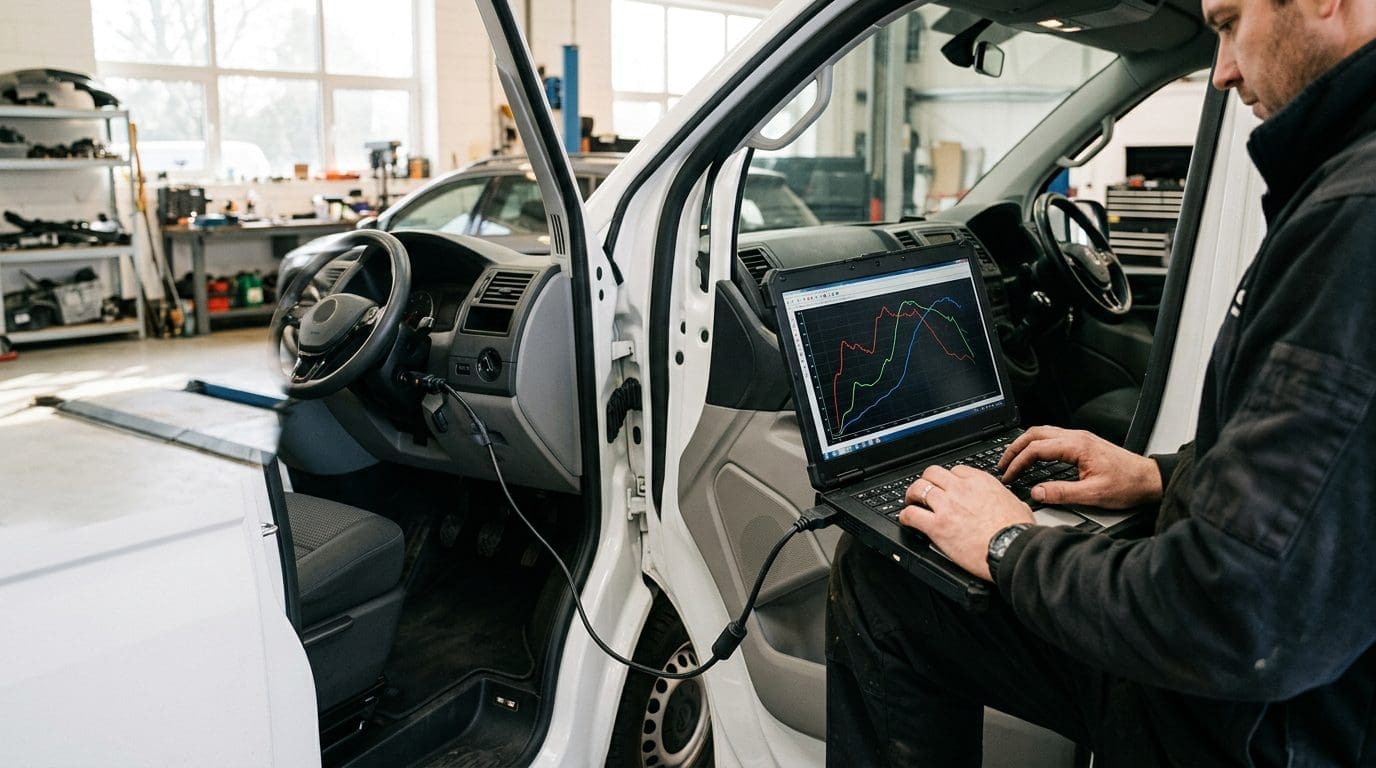
What is a gearbox remap? A gearbox remap, or TCU tune, rewrites the software in the transmission control unit rather than the engine ECU. It adjusts shift points, clutch and line pressure, shift speed, kickdown behaviour and the gearbox torque limiter, so the car changes gear the way you want and can safely carry the torque an engine tune produces.
The ECU is only half the story
Most drivers know an ECU remap changes fuelling and boost. Far fewer know that on a modern automatic there is a second computer sitting behind it, and that computer has a veto.
The transmission control unit (TCU, sometimes called the TCM) decides when to shift, how hard to clamp the clutches, how fast to swap gears and, crucially, how much torque it will accept from the engine before it starts protecting itself. That last figure is a hard number written into the software. If the engine tries to send more torque than the gearbox map allows, the TCU does not politely absorb it. It pulls torque, softens the shift, or in stubborn cases drops the car into limp mode.
That is why a car can be given a well-executed engine remap and still feel oddly flat in third and fourth gear. The engine is willing. The gearbox is not.
ECU tune vs TCU tune, in one line each
- ECU tune changes how much torque the engine makes.
- TCU tune changes how much of it the gearbox will pass on, and how the car behaves while it does.
They are separate jobs on separate control units, and on some platforms they are separate tools and separate read-and-write procedures. Anyone quoting you a single click-and-go price for both without asking which gearbox you have is guessing.

Which gearboxes can actually be tuned?
This is where a lot of online advice goes vague. Not every automatic has a remappable TCU, and a few have none worth touching.
| Gearbox type | Examples | Tunable? | What usually changes |
|---|---|---|---|
| Dual-clutch (DCT) | VAG DSG / S tronic, Ford PowerShift, BMW DCT | Yes, usually the strongest case | Clutch clamping pressure, shift speed, torque limiter, launch behaviour |
| ZF torque-converter 8-speed | BMW, Jaguar Land Rover, many others | Yes on most model years | Shift points, lock-up strategy, torque limiter, shift firmness |
| Aisin / other torque converter | Various Japanese and European fitments | Sometimes, platform dependent | Shift mapping and lock-up, limited pressure control |
| CVT | Various hybrids and small petrols | Rarely worthwhile | Ratio strategy only; little meaningful headroom |
| Manual | Any | No TCU exists | Nothing – clutch capacity is a mechanical question |
Coverage moves with model year and control-unit hardware revision, so the only honest answer for a specific car comes from reading the unit and checking it against current tool coverage.
The five things a TCU tune genuinely changes
1. Shift points
Factory shift maps are built around emissions cycles and a broad customer base. That usually means shifting up early to keep revs and consumption down. On a tuned engine that puts the car below the part of the rev range where the new torque lives. Moving shift points is often the single biggest change in how the car feels.
2. Clutch and line pressure
On a dual-clutch box, clamping pressure is what stops the clutch packs slipping under load. Add torque without adding pressure and you get slip, and slip is heat, and heat is what kills clutch packs. Raising pressure appropriately is a protective measure, not a performance one.
3. Shift speed
Faster shifts feel dramatic and demo well. They also load the drivetrain harder. There is a sensible window here, and the top of it is not where a daily-driven family car should live.
4. Kickdown and gear-hold logic
A lot of the everyday annoyance with modern autos is hunting between gears on a gentle incline, or refusing to hold a gear through a roundabout. That is logic, not hardware, and it can be reworked.
5. The torque limiter
The gate on everything else. Raised carefully and within the box’s real mechanical capability, it lets an engine tune actually be felt. Raised carelessly, it simply moves the failure from the software to the clutch packs.
What most guides get wrong about gearbox remapping
The common framing is that a TCU tune is a performance upgrade you bolt on after an engine remap for a bit more drama. We would put it almost the opposite way round.
On a car that has had a properly executed Stage 1 engine tune, the TCU work is mostly a protective and driveability measure. It stops the gearbox fighting the engine, stops the torque limiter clipping the new curve, and stops the clutch packs seeing load they are not clamped for. The extra sharpness is a by-product.
Framed that way, two things follow. First, a gearbox tune on a standard, untuned car is often a small change and occasionally not worth doing at all. Second, an aggressive engine map on an untouched TCU is the combination most likely to cause you a problem, and it is unfortunately the combination sold most often. If you have already had a remap elsewhere and the car now shifts oddly, that is worth investigating before you assume the engine map is at fault – and it is one of the first things we look at during a proper diagnostic and power check.
Do you have to tell the DVLA or your insurer?
These get conflated constantly, and they are two different questions with two different answers.
DVLA and your V5C
The DVLA’s list of changes you must record on your V5C registration certificate covers colour, engine, cylinder capacity, fuel type, seating capacity, the weight of a large vehicle, and chassis or bodyshell changes. Control-unit software is not on that list. Reflashing a TCU does not change your cylinder capacity or your fuel type, so there is nothing to update.
Your insurer
Different question entirely. Insurers set their own terms, and a performance modification is materially relevant to them whether or not the DVLA cares. Declare it. We cover the reasoning in full in our guide to how remapping interacts with UK testing and legal requirements. The short version: an undeclared modification is the cheapest possible saving until the day you need to claim.
And the MOT?
Worth knowing that the MOT test does not cover the condition of the engine, clutch or gearbox. A gearbox tune is not an MOT item. That is a statement about what the test inspects, not a licence to run a box beyond its capability – the test simply is not looking at it, which is all the more reason to have the work done by someone who is.
When we would tell you not to bother
The clutch packs are already tired
Judder on pull-away or slipping under load means wear. A software change will not restore a worn clutch pack, and raising pressure on a tired one buys weeks, not years.
The gearbox oil is long overdue
DCT and torque-converter boxes both live on their fluid. Service history first, software second. Doing it the other way round is how people end up blaming the tune.
There is a stored fault
An existing mechatronic or sensor fault needs resolving on its own terms. Writing new maps over a live fault hides nothing and fixes nothing.
The car is a CVT or a manual
On a CVT the headroom is usually too small to justify the work. On a manual there is no TCU at all – clutch capacity is a mechanical conversation.
Frequently asked questions
Will a gearbox remap damage my transmission?
Done within the box’s real mechanical limits, with healthy clutch packs and fresh fluid, no. The risk comes from raising the torque limiter without raising clamping pressure to match, or from stacking an aggressive engine map onto an untouched TCU. Both produce slip, and slip produces heat.
Can you remap a gearbox without remapping the engine?
Yes, and occasionally it is the right call – if your only complaint is early upshifts or gear hunting, the fix is in the TCU. But on a standard car the gains are modest, because the factory torque limiter is not the thing holding you back yet.
Does a gearbox remap improve fuel economy?
Sometimes, marginally, by holding a taller gear at cruise and locking up the converter sooner. It is not a fuel-saving modification in its own right. Driving style still dominates, as we set out in our look at what remapping really does for MPG.
Can a gearbox remap be reversed?
Yes, provided the original file was read and stored before any changes were written. That original read is the single most important part of the job and should be non-negotiable.
Not sure whether your gearbox is the bottleneck?
If your car has been remapped and still feels like it is being held back, or it hunts between gears where it never used to, the transmission software is a sensible place to start looking. We read the unit, check the stored data and tell you honestly whether there is anything worth changing.
Talk to us about your gearbox See our Stage 2 tuning
Pro Remapping, Stoke-on-Trent and across Staffordshire. Every job starts with a full original file read.


