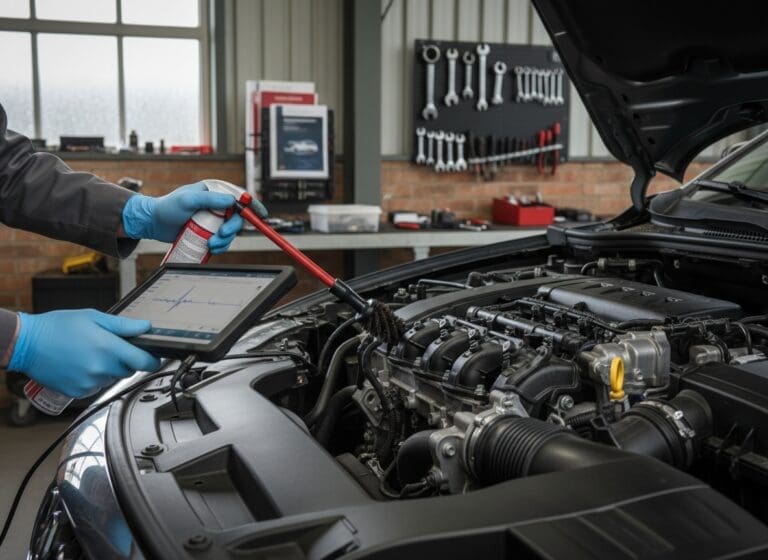

A clear breakdown of EGR valve cleaning prices in the UK, what the process involves, and how to decide if cleaning is worth it for your vehicle.
What Is EGR Valve Cleaning and Why Does It Matter?
The EGR (Exhaust Gas Recirculation) valve is a component found on virtually every modern diesel engine. Its job is to redirect a portion of exhaust gases back into the intake manifold, which reduces combustion temperatures and lowers nitrogen oxide (NOx) emissions. In theory, it’s an elegant emissions solution. In practice, it’s one of the most problematic components on a diesel vehicle.
The problem is carbon. Exhaust gases are laden with soot, oil vapour, and combustion deposits. As these pass through the EGR valve thousands of times, they gradually coat the valve’s internals with thick carbon buildup. Over time, this restricts movement, causes the valve to stick open or closed, and triggers fault codes. The result is poor engine performance, rough idling, increased fuel consumption, and often a check engine light on the dashboard.
EGR valve cleaning is the process of removing this carbon buildup without replacing the valve entirely. Done correctly, it can restore smooth operation and clear the associated fault codes — at a fraction of the cost of a new valve.
EGR Valve Cleaning Costs in the UK (2026)
Prices vary depending on the cleaning method, the vehicle, and where you have the work done. Here’s a clear breakdown of what each approach costs and what it delivers.
| Method | Typical Cost | Effectiveness | Best For |
|---|---|---|---|
| Chemical flush (in-situ) | £80–£130 | Moderate | Light buildup, early-stage faults |
| Manual removal and clean | £120–£200 | Good | Moderate buildup, sticking valves |
| Ultrasonic cleaning | £150–£250 | Excellent | Heavy buildup, recurring faults |
| EGR valve replacement | £300–£800+ | Definitive | Seized, cracked, or failed valves |
Labour rates vary regionally. In the Stoke-on-Trent and Staffordshire area, EGR cleaning sits toward the lower end of national pricing. In London and the South East, expect to pay 20–30% more for the same procedure.
What Affects the Final Price?
Several factors influence how much you’ll pay for EGR cleaning on your specific vehicle:
- Engine access: On some vehicles the EGR valve is buried under other components, adding labour time.
- Severity of buildup: Heavily coked valves take longer to clean and may need ultrasonic treatment.
- EGR cooler condition: If the cooler is also clogged, this adds to the job.
- Fault code diagnosis: If a diagnostic session is needed first, this is usually charged separately at £40–£80.
What Does EGR Valve Cleaning Involve?
The exact process depends on the chosen method, but for a workshop-level clean the process follows a consistent pattern.
Step 1: Diagnostic Scan
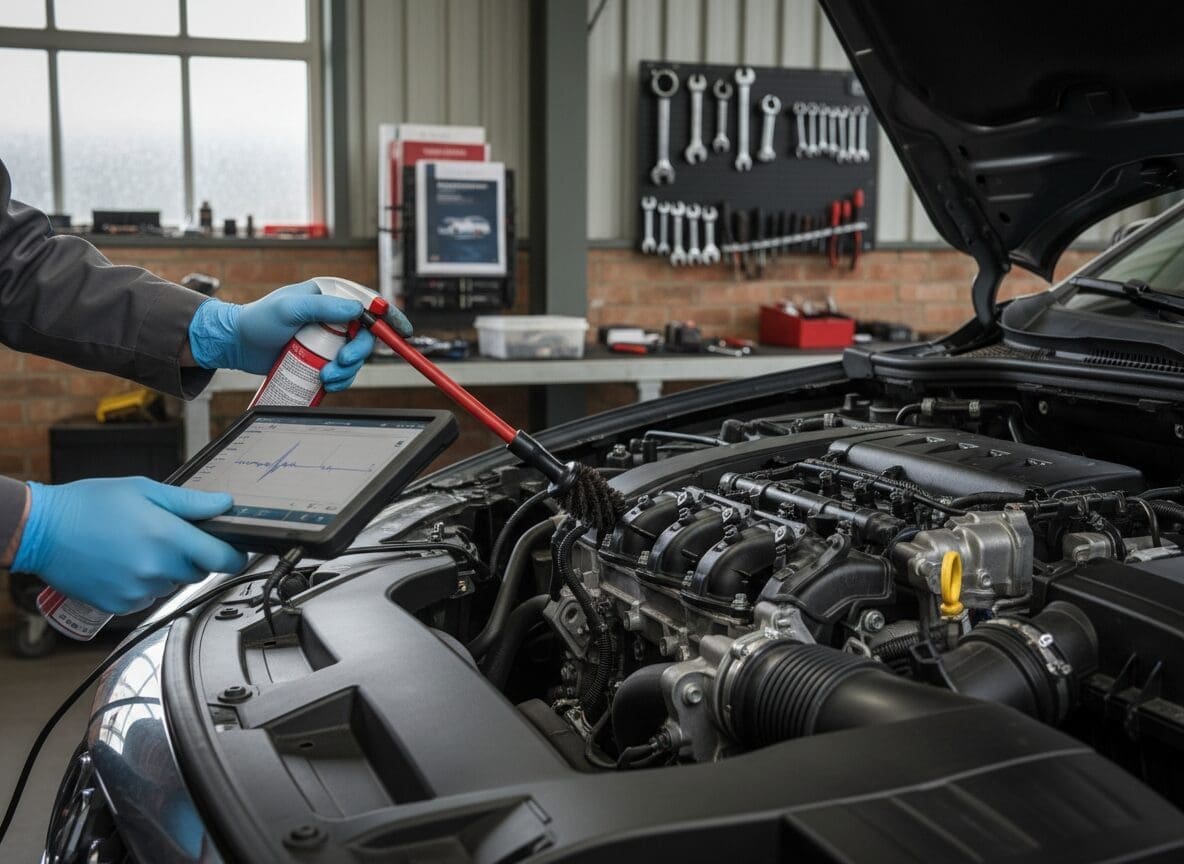
Before touching the valve, we connect to the vehicle’s OBD port and run a full live data scan. This confirms that the EGR valve is the actual source of the fault codes and checks whether related systems — MAF sensor, boost pressure, intake temperature — are also affected.
Step 2: Removal
The EGR valve is removed from the engine. On most diesel vans and cars this involves disconnecting the electrical connector, removing the vacuum or electronic actuator, and unbolting the valve from the intake manifold. The EGR cooler is usually inspected at this point too.
Step 3: Carbon Removal
Carbon deposits are removed using a combination of chemical solvents and mechanical scrubbing. For severe cases, ultrasonic cleaning tanks break up and remove deposits that chemical methods can’t reach. The valve is then thoroughly inspected for cracks, wear on the valve seat, or actuator damage.
Step 4: Refitting and Testing
The clean valve is refitted with a new gasket, fault codes are cleared, and the vehicle is tested on live data to confirm the valve is opening and closing correctly across the rev range.

Signs Your EGR Valve Needs Cleaning
EGR valves don’t fail overnight. The buildup is gradual, and so are the symptoms. These are the most common signs that your EGR valve needs attention.
Performance Symptoms
- Rough idle, especially when warm
- Hesitation or flat spot under acceleration
- Loss of power, particularly at low revs
- Engine hunting or surging at low speed
- Increased fuel consumption
Warning Signs
- Check engine light with P0401, P0404, P0405 codes
- Black smoke from the exhaust
- Strong smell of exhaust fumes in the cabin
- Failed emissions test at MOT
- Limp mode or reduced engine power
Which Vehicles Are Most Affected?
EGR problems are particularly common on vehicles used predominantly for short journeys. Short-trip driving never allows the engine to reach full operating temperature, which means exhaust gases are cooler and deposit more carbon with each recirculation cycle. Diesel vans used on delivery routes, diesel cars used for school runs, and low-mileage diesels all tend to develop EGR issues earlier than vehicles driven regularly on longer runs.
VW Transporter
Vauxhall Vivaro
Renault Master
Mercedes Sprinter
BMW 3 Series diesel
Peugeot Boxer
Citroen Relay
EGR Cleaning vs EGR Delete: Which Is Right for You?
This is where the decision gets more nuanced. EGR cleaning restores the valve to working condition and keeps the vehicle in its original emissions configuration. EGR deletion removes the valve from the equation entirely — the EGR circuit is blanked off and the ECU is remapped to run without it.
When Cleaning Makes Sense
Cleaning is appropriate when the valve is still functioning but restricted by carbon. If your vehicle is relatively new, has a valid MOT, or is used commercially where MOT compliance matters, cleaning is typically the right approach. It’s also the right first step if you haven’t previously tried cleaning — there’s no point deleting a valve that simply needed maintenance.
When Deletion Makes More Sense
Deletion becomes the more logical option when cleaning has already been tried and the fault has recurred, when the valve is seized or physically damaged, or when the vehicle is used off-road or on private land where MOT compliance is not a requirement. Some operators in agriculture, motorsport, or specific commercial applications choose deletion as a permanent solution to recurring EGR problems.
If you’re unsure which route is right for your situation, our team can walk you through it without pressure. We carry out both cleaning and EGR delete services depending on what’s appropriate for the vehicle and its use case.
How Long Does EGR Valve Cleaning Last?
On a vehicle driven regularly on longer runs, an EGR clean can last 30,000–50,000 miles before significant carbon accumulation recurs. On a van used exclusively for urban short-trip delivery work, the buildup can return much faster — sometimes within 12,000–20,000 miles.
If you find yourself cleaning the EGR repeatedly, it’s worth looking at the underlying cause. Frequent short-trip use is the most common culprit. Running the vehicle on a longer motorway run at least once a fortnight can slow the rate of carbon accumulation significantly. Some owners also use periodic DPF regeneration runs to keep the entire exhaust system cleaner.
If the EGR cooler is also clogged, cleaning the valve alone will only partially solve the problem. A clogged cooler pushes deposits back into the valve faster and can cause coolant contamination if left untreated.
Get Your EGR Valve Assessed
We’re based in Fenton, Stoke-on-Trent and carry out EGR cleaning, diagnostics, and delete services for vehicles across Staffordshire. Get in touch to discuss your vehicle’s symptoms and we’ll give you a straight recommendation.
Fenton, Stoke-on-Trent
ST4 3ER
Serving: Stoke, Newcastle-under-Lyme, Stafford, Congleton, Leek, Uttoxeter
Frequently Asked Questions
Can I drive my van with an EGR fault code?
In most cases yes, but you may notice reduced performance or the vehicle entering limp mode under load. It’s worth getting the fault checked promptly — a stuck-open EGR valve can affect fuel economy significantly, and a stuck-closed valve can cause issues under heavy load.
How much does EGR valve cleaning cost in Stoke-on-Trent?
EGR cleaning at Pro Remapping is priced based on the vehicle and severity of the buildup. Get in touch for a quote specific to your van or car. As a guide, most EGR cleans fall in the £100–£220 range for the labour and cleaning process.
Will EGR cleaning clear my P0401 or P0404 fault code?
In most cases yes, provided the fault is caused by carbon restriction rather than a mechanically failed valve. We run a diagnostic first to confirm the fault source before starting any cleaning work.
Does EGR cleaning void my vehicle warranty?
Cleaning is a maintenance procedure and does not void any warranty. EGR deletion is different — this involves a software remap and physical modification, which does affect the vehicle’s emissions configuration.
How do I know if my EGR cooler also needs attention?
If your vehicle is consuming coolant without a visible leak, or if the heater performance has dropped, the EGR cooler may be failing. We check the cooler condition as part of any EGR diagnostic appointment.
Pro Remapping, 201 King Street, Fenton, Stoke-on-Trent, ST4 3ER. Diesel diagnostics, EGR cleaning, and ECU remapping across Staffordshire.