

Tuning Box vs Remap: Which Actually Gives Real Gains on a Diesel?
A plug-in box does not talk to your engine. It talks to your ECU, and it lies. Understanding what it lies about tells you exactly where the gains come from — and where they stop.
Tuning box vs remap: a tuning box sits between a sensor and the ECU and alters the signal, so the ECU fuels more than it intended. A remap changes the ECU’s own calibration. The box cannot move the limits the ECU enforces; the remap can. That single difference explains almost every practical distinction between them.
Search “tuning box vs remap” and you get two camps shouting past each other. Box sellers say it is reversible, safe and just as effective. Tuners say it is a resistor in a plastic case. Neither description is much use if you are standing in front of a diesel wondering which to buy.
So this guide does something different. It starts with what the box is physically connected to, because once you know that, every claim on both sides becomes easy to test.
What a diesel tuning box is actually plugged into
On a modern common-rail diesel, fuel pressure is not a fixed thing. The rail pressure sensor reports the pressure in the rail to the control unit, which regulates system pressure and controls the injectors accordingly. The ECU sets a target, reads the actual value back, and closes the loop.
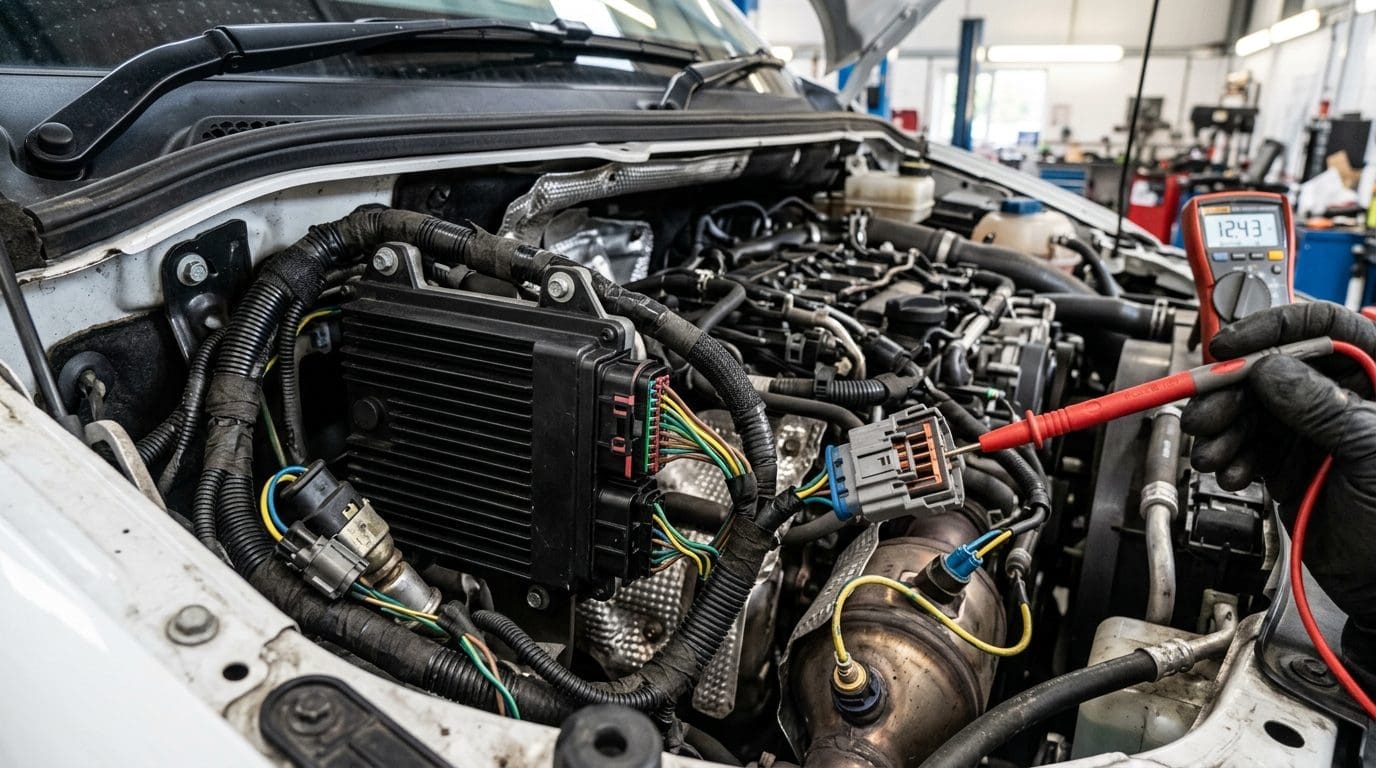
The classic plug-in tuning box interrupts that loop. It sits on the rail pressure sensor connector and reports a pressure slightly lower than the real one. The ECU sees a shortfall it did not expect, commands the pump to raise pressure to hit its target, and the injectors deliver more fuel per pulse than the calibration ever intended.
Some boxes work on different signals — MAP or boost pressure is the other common one — but the principle is identical. The box does not add power. It changes what the ECU believes, and the ECU adds the power on its behalf.
Why that matters more than it sounds
Every safety strategy in the engine is written against the values the ECU thinks it is seeing. Torque limiters, smoke limiters, exhaust gas temperature protection, boost overrun cuts and injector quantity ceilings are all applied to a picture that now has a deliberate error in it.
The engine is not being protected less carefully. It is being protected carefully against the wrong numbers.

What a remap changes instead
A remap writes new values into the ECU’s own calibration maps. Fuelling, boost targets, injection timing and, critically, the limiter tables themselves are all addressable.
That means a properly written file raises the ceiling and then fuels up to it, rather than fooling the engine into running past a ceiling that is still set where the factory left it. The ECU knows exactly what it is doing, because it is doing what it has been told.
It also means every sensor keeps reading true. Diagnostics stay meaningful, live data matches reality, and a fault that appears later is a real fault rather than an artefact of a modified signal.
The box
- Alters a sensor signal in real time
- Cannot address torque or smoke limiters
- Unplugs in minutes
- Same hardware moves between cars
- Sensor readings no longer reflect reality
The remap
- Rewrites the ECU’s own maps
- Limiters can be raised deliberately and tested
- Reversible if the original file was saved
- Written for that engine and its condition
- Diagnostics stay honest
“But the box gave me more BHP”
Sometimes it genuinely does, and pretending otherwise is why tuners lose these arguments. On an engine with a lot of headroom and conservative factory fuelling, a box can produce a real and noticeable change in mid-range shove.
Two things are usually true at the same time, though. The gain arrives as a broad increase in fuelling rather than a shaped power curve, and it tails off where the ECU’s own limiter finally intervenes, because the box has no way to move that limiter.
That is why box gains often feel strong at 2,000rpm and disappointingly flat further up. It is not a marketing failure. It is the shape of the mechanism.
On the numbers: we do not publish generic gain figures for either option, and we would be sceptical of anyone who does. What an engine will make depends on its variant, its condition, its turbo, its fuel system and its mileage. A rolling-road or logged before-and-after on your car is worth more than any table.
Fuel without air: the part box marketing skips
A diesel makes torque by burning fuel in available air. Add fuel without adding air and you do not get proportionally more power — you get a richer burn, higher exhaust gas temperature and more soot.
A remap can raise the boost target alongside the fuelling, so the air arrives to match. A sensor-signal box working on rail pressure alone cannot do that. Where a box does intervene on the boost signal instead, it is then not adding the fuel, and the same mismatch appears from the other direction.
This is the practical reason box gains so often come with a puff of smoke on a hard pull. The smoke is unburnt fuel. It is also the reason we are cautious about fitting anything of the sort to a car with a particulate filter that has already been regenerating frequently — you are feeding the exact thing that blocks it.
What we see come through the workshop
The cars that arrive with box-related complaints are rarely dramatic failures. They are cars that have started regenerating more often, cars where the turbo actuator has begun sticking, and cars where a diagnostic scan shows plausible-looking data that does not match how the engine feels. In each case the box was not the only cause, but it had taken away the margin that was covering the real problem.
The emissions and MOT reality
This is where the “it just unplugs” argument gets tested. Modifying how an engine fuels does not change the standard it is tested against. The DVSA inspection manual sets the metered diesel smoke test out plainly, with vehicles checked against the manufacturer’s plate value where one is present and a reading above the applicable limit failing the test.
A box that adds fuelling without touching the smoke limiter is, by definition, pushing the engine toward more particulate output than the calibration was written to allow. On a car with a healthy DPF that may never show up. On a car with a marginal one, it accelerates the problem.
A remap written by someone who tests against the emissions standard has no such tension in it, because the limits were part of the brief rather than an obstacle to route around.
So which should you buy?
Our position, stated plainly: if you want the car to feel different for a few months and then go back to standard with no trace, a box is a legitimate choice and we will not pretend it is worthless.
If you want a lasting change to how the car drives, want the DPF and turbo to survive it, and want your diagnostics to keep telling you the truth, the box is the wrong tool. Not because it is fake, but because it is working around the ECU instead of with it.
The one case we would argue hardest about is a diesel with any existing running issue. Neither option is a repair. Diagnose first, fix what is actually wrong, then decide on power. If you want the background on how ECU calibration works before deciding, our explainer on what chip tuning does and why people consider it covers the fundamentals, and our Stage 1 remapping service page sets out what we actually do to a car.
Torque limiters
Diagnose first
Test, do not guess
Frequently Asked Questions
Are tuning boxes bad for your engine?
Not automatically, but the risk profile is different to a remap. Because a box works by altering a sensor signal, the ECU’s protection strategies are being applied to values that are deliberately wrong. On a healthy engine with headroom that is often uneventful; on a tired one it removes margin you may need.
Can a tuning box be detected?
The hardware is visible to anyone who opens the bonnet and looks at the sensor connectors, and a diagnostic session can show implausible live values. It is less a question of detection than of whether anyone thinks to look.
Is a tuning box better than a remap for fuel economy?
Neither reliably improves economy on its own. Both change how much fuel is delivered for a given pedal position, so consumption follows driving style more than it follows the modification. Treat economy claims from either camp with caution.
Can you fit a tuning box and a remap together?
You can physically, and you should not. The box distorts the signals the remapped calibration is relying on, so the two work against each other. If a car comes to us with a box fitted, we remove it before writing anything.
Does a tuning box work on petrol cars?
Some are sold for petrol engines, but the common-rail pressure trick that makes diesel boxes effective does not translate directly. Petrol applications generally intervene on boost or throttle signals instead, and the results are far more variable.
Reviewed and signed off by Pro Remapping— ECU calibration, DPF and diagnostic specialists working across Stoke-on-Trent and Staffordshire. General guidance only; every vehicle differs, so speak to us about yours.