Eolys Fluid Explained: The DPF Additive Most Drivers Have Never Heard Of
If your Peugeot, Citroën, Ford or Volvo diesel keeps blocking its filter despite plenty of motorway miles, there is a second tank you have probably never topped up.
There is a category of DPF problem that no amount of motorway driving will fix, and it catches out good garages as well as drivers. The vehicle regenerates on cue, the soot load looks sensible, and yet the filter keeps loading up faster than it should. On a PSA-derived diesel — and on plenty of Fords, Volvos and Mazdas built on the same after-treatment idea — the answer is often sitting in a small plastic tank near the fuel tank that nobody has looked at since the car was built.
What is Eolys fluid? Eolys is a cerium-based fuel-borne catalyst dosed into the diesel tank in tiny quantities each time the vehicle is refuelled. It is stored in its own reservoir, separate from the fuel and separate from AdBlue, and its job is to lower the temperature at which trapped soot burns off. When the tank runs dry, the filter loses its chemical assistance and starts blocking even on driving that used to keep it clear.
It is not AdBlue and it is not a bottle of something you pour in at Halfords. It is a factory-dosed system, refilled with the correct fluid for the vehicle, and reset in software afterwards so the ECU knows the tank is full again. Missing that last step is the single most common reason the warning comes back a week later.
Eolys, FAP and the difference from a normal DPF
Most diesels burn their soot off with heat alone. The engine injects extra fuel late in the cycle, exhaust temperature climbs high enough to oxidise the soot, and the filter clears. That is a standard DPF regeneration, and it needs a sustained, warm, loaded run to work properly.
The PSA approach — badged FAP, from filtre à particules — adds chemistry to the heat. Cerium from the additive travels through combustion with the fuel and ends up embedded in the soot itself. Because the soot now has a catalyst mixed through it, it ignites at a meaningfully lower temperature than untreated soot would.
DS
Ford (shared PSA diesels)
Volvo
Mazda
Some Mini and Fiat applications
The practical consequence is the bit that matters to you. A FAP system was designed around the assumption that the additive is present. Take the additive away and you are asking a filter engineered for assisted regeneration to behave like an unassisted one — on the same short school runs and the same cold mornings it always did.
Solvay, the chemical company that developed Eolys and supplies it to manufacturers, sizes the on-board reservoir at roughly one to two litres and designs it to last a couple of hundred thousand kilometres of normal use. That is why it is invisible: on a great many vehicles it genuinely never needs touching within the first owner’s tenure. On a fifteen-year-old car on its fourth owner, it is a different story.
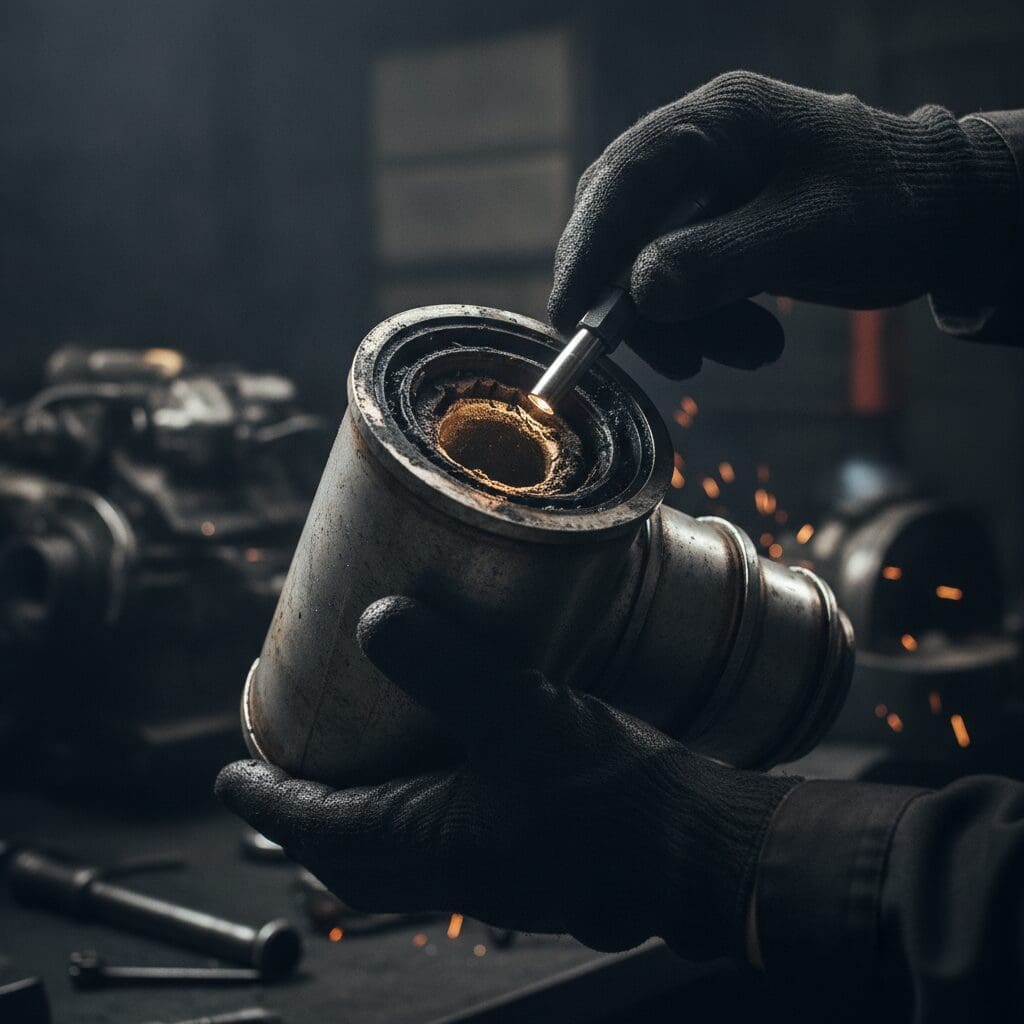
The symptoms of a low or empty additive tank
The tell is almost always a mismatch between how the car is driven and how the filter behaves. Everything else on the list follows from that.
- A generic “Anti-pollution fault” or “Engine fault: repair needed” message, often with no dramatic driveability change at first
- DPF or particle-filter warnings appearing on a vehicle that gets regular long runs
- Regenerations happening far more often than they used to, or starting and failing repeatedly
- A filter that has been professionally cleaned and blocks again within months
- Fuel consumption creeping up as the engine spends more of its life in regeneration
The trap. Because the dash message is generic, this fault is regularly misdiagnosed as a failing DPF. The filter gets condemned, replaced, and blocks again — because the actual missing ingredient was never in the exhaust system at all. Always confirm the additive level and the dosing counter before signing off a filter as dead.
How a proper additive service is done
Refilling an Eolys system is not just pouring fluid in. There are four steps and skipping any of them produces a car that behaves exactly as it did before.
- Confirm the fault. Read the additive-related codes and the dosing counter, and check the pump is actually being commanded. An empty tank and a dead dosing pump look similar from the driver’s seat and cost different amounts to fix.
- Use the right fluid. Different generations of the system take different products. The wrong one is not a like-for-like substitute.
- Refill to the correct level. The reservoir is sized to the vehicle, not to the bottle.
- Reset the counter in software. The ECU tracks additive consumption rather than measuring the tank directly on many applications, so without the reset it will keep insisting the tank is empty.
Once that is done, the filter itself usually still needs attention, because it has been loading up without help for however long the tank has been dry. That is a separate job, and our page on professional DPF cleaning explains what is involved, while the guide to off-vehicle cleaning versus a forced regeneration covers which of the two your filter actually needs.

The cerium ash problem nobody mentions
Here is the honest downside of the technology, and it is one the additive suppliers are rather quieter about. Cerium is a metal. When it burns with the soot it does not disappear — it leaves behind an incombustible ash that no regeneration will ever remove.
That ash accumulates permanently. It is one reason additive-equipped filters have a finite working life measured in miles rather than in cleanings, and it is why an older FAP filter sometimes will not come back no matter how good the cleaning process is. If a specialist tells you a high-mileage FAP filter is beyond cleaning, that is frequently a genuine assessment rather than an upsell.
Our view. Check the additive before you condemn the filter, and check the filter’s ash loading before you promise a customer that cleaning will fix it. Most of the disappointing outcomes we see on these vehicles come from getting those two checks in the wrong order.
Where the law sits on all this
Some drivers reach the same conclusion at this point: if the filter is ash-loaded and the additive system is another thing to maintain, why not just remove the lot? Worth being clear about the position on a road-registered vehicle.
Since February 2014, the MOT exhaust inspection has included a check for the presence of a filter, and DVSA states plainly that a missing DPF, where one was fitted when the vehicle was built, will result in an MOT failure. The same guidance sets out the potential penalties for using a vehicle modified so it no longer meets its original emissions standard — fines of up to £1,000 for a car and £2,500 for a light goods vehicle. Testers are also instructed to reject a filter showing evidence of tampering.
So on a road car the sensible route is to sort the additive, clean or replace the filter, and get the system doing the job it was designed to do. Our existing article on why DPF removal is against the law goes into the legal detail, and the piece on how short journeys ruin a DPF covers the driving-pattern half of the problem.
Common questions
Is Eolys the same as AdBlue?
No. AdBlue is a urea solution injected into the exhaust to convert oxides of nitrogen in the SCR catalyst. Eolys is a cerium additive dosed into the diesel fuel to help the particulate filter burn off soot. Different tank, different chemical, different job. A vehicle can have both.
How often does Eolys fluid need topping up?
It is not a regular service item. The tank is sized to last well into six-figure mileages, so most vehicles need it once, if at all, and usually only in later life. If yours has needed refilling twice in quick succession, suspect a leak or a dosing fault rather than normal consumption.
Can I top up the DPF additive myself?
The refill itself is mechanically straightforward on some models, but the software reset generally is not — and without it the vehicle keeps reporting the tank as empty. You also need the correct fluid for your system generation. In practice it is a job worth having done and reset properly in one visit.
Which cars actually use a DPF additive?
Predominantly Peugeot, Citroën and DS models with the FAP system, plus Fords, Volvos, Mazdas and some Mini and Fiat models that used PSA-derived diesel engines. If you are unsure, the giveaway is a second small reservoir near the fuel tank and an additive-related item in the service schedule.
Filter keeps blocking? Let us check the additive first
We read the dosing counter and the additive fault history before we quote for anything on the filter itself. It is a five-minute check that has saved plenty of Staffordshire drivers the cost of a DPF they did not need.
About the author. Reviewed and signed off by Pro Remapping. We work on diesel after-treatment faults — DPF, EGR, SCR and additive systems — across Staffordshire and Cheshire every week.
Any price we give for additive or filter work is quoted per vehicle after diagnosis and is not a fixed price list. Nothing on this page is a quotation.