Got a P2002 code logged against your diesel? Here’s what it means, why it appears, and what you actually need to do to clear it properly.
What Does P2002 Actually Mean?
P2002 is an OBD-II fault code that stands for “Diesel Particulate Filter Efficiency Below Threshold — Bank 1.” In plain terms, it means the engine management system has detected that your diesel particulate filter (DPF) is not trapping soot and particulate matter to the level it should be.
The ECU monitors DPF efficiency through a combination of differential pressure sensors (which measure the pressure drop across the filter), temperature sensors, and — on some vehicles — particulate sensors downstream of the DPF. When the calculated soot-trapping efficiency drops below a programmed threshold, P2002 is stored and the engine warning light illuminates.
This code appears across a wide range of diesel vehicles, including common platforms like Ford Transit, Vauxhall, Volkswagen, Renault, Citroen, Peugeot, and BMW. It’s one of the more common DPF-related fault codes we diagnose at Pro Remapping in Stoke-on-Trent.
P2002 vs P2003: What’s the Difference?
P2002 relates to Bank 1 (the primary exhaust bank on most four-cylinder diesel engines). P2003 is the same fault on Bank 2, which only applies to V-configuration engines with two exhaust banks — such as some V6 and V8 diesel engines found in larger commercial vehicles or premium saloons.
On the vast majority of common UK diesel vans and cars, you’ll only ever see P2002 since the engine has a single bank. If you’re seeing P2002 and P2003 together, you’re working with a V-engine and should treat both banks as potentially affected.
Symptoms of a P2002 Fault Code
P2002 on its own doesn’t always produce dramatic symptoms — but the conditions that cause it usually do. Here’s what drivers typically notice before or alongside this code appearing:
- Engine warning light on dashboard — the first and most common sign
- Reduced power or limp mode — the ECU may limit engine output to protect the DPF and catalyst
- Excessive black smoke from the exhaust — particularly on acceleration, suggesting soot is bypassing the filter
- Increased fuel consumption — particularly if forced regeneration cycles are running more frequently
- Strong smell from the exhaust — can indicate unburnt particulate matter passing through
- Failed or interrupted DPF regeneration — the vehicle attempts to burn off soot but the filter cannot reach or hold the required temperature
- Additional codes alongside P2002 — such as P0087 (low fuel pressure), turbo codes, or injector codes that affect the combustion quality and exhaust temperature

What Causes P2002?
There are several distinct causes of a P2002 fault code, and the repair approach is different for each one. Treating them all as “the DPF needs replacing” is a common and expensive mistake.
1. Differential Pressure Sensor Failure
The DPF pressure sensor measures the pressure difference between the inlet and outlet of the filter. This reading tells the ECU how loaded the filter is with soot. A failed or stuck sensor can give an incorrect reading — either showing the filter as more blocked than it is, or showing apparent bypass when the DPF is actually working correctly.
Pressure sensor failure is the most common cause of a false P2002 code. The sensor itself is relatively inexpensive and straightforward to replace. A diagnostic will confirm whether the sensor reading matches expected values for the current filter condition.
2. Physical DPF Damage (Cracked Substrate)
If the DPF substrate has cracked — through thermal shock, an impact, or internal damage from incorrect regeneration — soot passes through the cracks rather than being trapped. The downstream sensors detect this bypass and store P2002. A cracked DPF cannot be repaired; it requires replacement.
DPF substrates can crack from: forced regeneration at very high soot loads, coolant contamination of the exhaust, or physical impact. Understanding how DPF regeneration works can help prevent unnecessary thermal stress on the filter.
3. Severely Blocked DPF
A DPF that has reached maximum soot loading — typically because the vehicle has been driven on many short journeys without completing passive or active regeneration — can fail an efficiency test even if structurally intact. At this point, the filter may need professional cleaning or forced regeneration to restore function. If cleaning fails to restore efficiency, replacement follows.
4. Failed Regeneration Due to Engine Faults
Successful DPF regeneration requires the exhaust to reach a high temperature — typically above 550°C — for a sustained period. Engine faults that affect exhaust temperature can prevent this. Low fuel pressure (P0087), failing glow plugs, weak injectors, or a stuck-open EGR valve can all reduce exhaust temperature and interrupt regeneration cycles.
In these cases, fixing the root cause (the engine fault) is essential before the DPF will regenerate correctly. Replacing the DPF without fixing the underlying engine fault will result in the same code returning quickly.
5. Oil or Coolant Contamination
Excessive oil consumption — from worn piston rings or a failing turbo seal — can contaminate the DPF with oil ash. Unlike soot, oil ash cannot be burned off during regeneration. Over time, ash loading reduces efficiency and eventually causes a permanent P2002. A coolant leak into the exhaust from a head gasket failure has the same effect.
6. Faulty Downstream NOx or Particulate Sensor
Some newer diesel vehicles use downstream particulate sensors in addition to pressure sensors to monitor DPF efficiency. A failed sensor of this type can trigger P2002 without any genuine DPF efficiency issue. Confirming sensor function before condemning the DPF is essential.
How to Fix P2002
The fix depends entirely on what the diagnostic reveals. Here are the most common repair paths:
Replace the Pressure Sensor
If the differential pressure sensor is faulty and giving incorrect readings, replacing it is the fix. Relatively low-cost and quick to carry out. Confirm with live data testing before and after.
Forced DPF Regeneration
If the DPF is blocked but structurally sound, a forced regeneration cycle — carried out via diagnostic software — can burn off accumulated soot and restore efficiency. The vehicle must be in the correct condition for this to work.
Professional DPF Cleaning
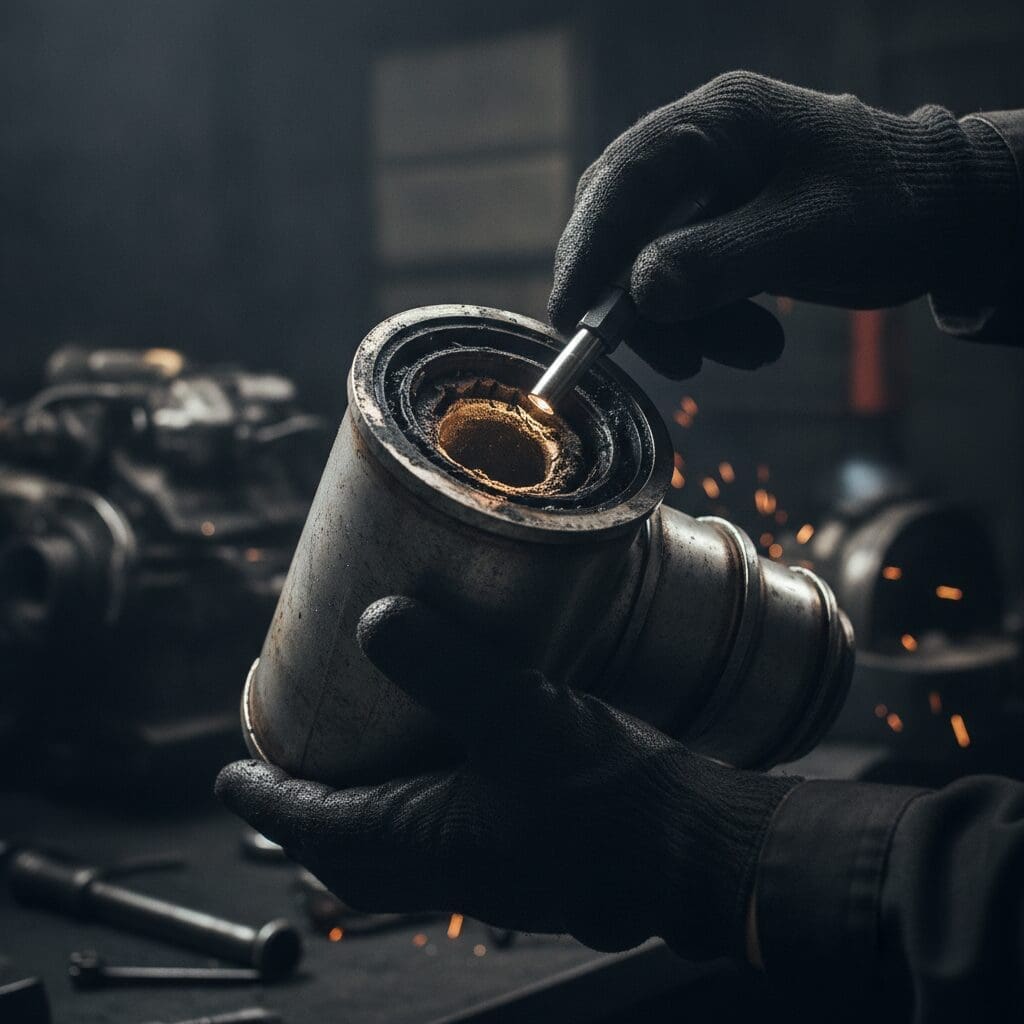
For filters with very high soot or ash loading, off-vehicle thermal cleaning or ultrasonic cleaning can restore efficiency. This is usually more cost-effective than replacement where the substrate is intact.
DPF Replacement
Where the substrate is cracked, oil-contaminated beyond cleaning, or ash-loaded to the point of no return, replacement is the only option. Aftermarket DPFs vary significantly in quality — genuine or OEM-equivalent parts are recommended.
P2002 Diagnostics in Stoke-on-Trent
At Pro Remapping in Stoke-on-Trent, we approach P2002 methodically. We start with a full live data read — checking differential pressure values, exhaust temperatures, fuel trims, and injector balance rates — before recommending any parts. This approach typically saves customers money by identifying the real fault rather than defaulting to DPF replacement.
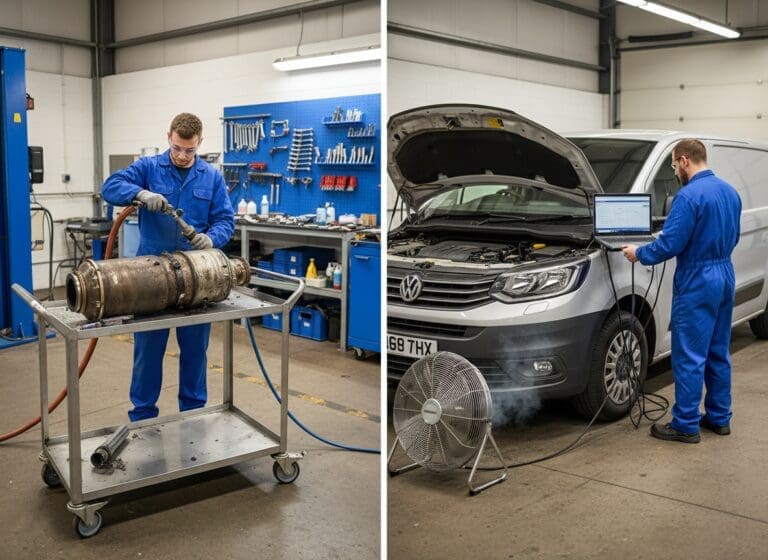
We also carry out forced DPF regeneration cycles in-house and can advise on whether professional cleaning is the right next step for your specific situation. We cover drivers from across Staffordshire, Cheshire, and the wider Midlands area.
If you’re running a diesel vehicle with a P2002 code logged, understanding the signs of a blocked DPF alongside this guide will help you understand the full picture before booking in.
P2002 Code on Your Diesel?
Get it properly diagnosed before spending on parts. Contact Pro Remapping in Stoke-on-Trent — we’ll give you a clear picture of what’s failed and the most cost-effective route to fix it.
DPF Specialists
Stoke-on-Trent
No Unnecessary Replacements
Frequently Asked Questions
Can I clear P2002 myself with an OBD reader?
You can clear the code with a basic OBD reader, but it will return if the underlying fault isn’t fixed. Clearing the code without addressing the cause does nothing to resolve the actual DPF efficiency issue.
Will a DPF cleaner additive fix P2002?
Additive-based DPF cleaners can sometimes assist a mildly blocked filter to regenerate, but they will not fix a faulty pressure sensor, a cracked substrate, or a DPF that’s ash-loaded beyond cleaning. They’re a very minor aid, not a fix for a fault code.
How much does it cost to fix a P2002 fault code?
Diagnostics are charged separately. If the fix is a pressure sensor replacement, it’s usually a few hundred pounds including parts and labour. If the DPF needs replacement, costs rise significantly depending on the vehicle. A proper diagnosis confirms which repair is actually needed before any commitment to parts.
Is P2002 an MOT failure?
An illuminated engine warning light will cause an MOT failure. If P2002 is the reason the light is on, you’ll need the fault resolved before the vehicle will pass. Additionally, a physically damaged or removed DPF will fail the MOT on the emissions test.
Can Pro Remapping diagnose P2002 near Stoke-on-Trent?
Yes. We cover Stoke-on-Trent, Newcastle-under-Lyme, Stafford, Leek, Congleton, Uttoxeter, and surrounding Staffordshire areas. Contact us to discuss your fault and get booked in.