
Pro Remapping — Stoke-on-Trent, Staffordshire
The U029D code means your vehicle’s ECU has lost communication with the NOx sensor module. Here’s what that means, why it happens, and what you can do about it.
Quick Answer
U029D is a CAN bus / network communication fault code indicating that the ECU has lost contact with the NOx sensor control module. It’s common on Euro 6 diesel vehicles with AdBlue systems and often appears alongside codes like P20EE, P204F, and P2201. The fix depends on the root cause — which could be a faulty sensor, damaged wiring, or a failed AdBlue module.
What Is the U029D Fault Code?
The U029D fault code belongs to the “U” family of OBD-II codes, which relate to network communication failures. Specifically, U029D means: “Lost Communication with NOx Sensor Module.”
Unlike engine or emissions fault codes (P-codes), U-codes point to a breakdown in the communication network within the vehicle — the CAN bus system that allows different control modules to talk to each other. When the ECU can’t receive data from the NOx sensor module, it logs U029D and in many cases triggers a warning light or puts the engine into a reduced performance mode.
The NOx sensor plays a critical role in Euro 6 diesel vehicles. It monitors nitrogen oxide emissions downstream of the catalytic converter and SCR (Selective Catalytic Reduction) system. The ECU uses this data to control how much AdBlue is injected. When communication fails, the engine management system can’t regulate emissions correctly — and the vehicle flags a fault.
029D = NOx Sensor Module
Euro 6 Diesel
AdBlue Systems
Which Vehicles Are Commonly Affected?
U029D can appear on any Euro 6 diesel vehicle fitted with an SCR/AdBlue system, but it is most frequently reported on:
- Volkswagen Group vehicles — VW Transporter T6/T6.1, Crafter, Touareg, Passat, and Tiguan with 2.0 TDI BiTDI engines
- Mercedes-Benz — Sprinter, Vito, C-Class, E-Class, and GLC with OM651 and OM654 diesel engines
- Ford — Transit and Transit Custom with 2.0 EcoBlue engines (common from 2019 onwards)
- Stellantis vans — Peugeot Boxer, Citroën Relay, and Fiat Ducato with Euro 6 engines
- BMW and MINI — B47 and N47 diesel engines fitted with SCR systems
- Audi and SEAT — A4, A6, Q5, and Leon with Euro 6 TDI engines
What Causes U029D?
There are several possible root causes for a U029D fault code. The code itself only tells you that communication has failed — it doesn’t pinpoint the exact cause. A proper diagnostic session is needed to confirm which of the following is responsible:
1. Faulty NOx Sensor
The NOx sensor itself has failed. These sensors operate in extremely high temperatures at the exhaust and can degrade over time, particularly on high-mileage vehicles. When the sensor fails completely, the signal disappears and the ECU logs a communication loss. This is one of the most common causes.
2. Damaged or Corroded Wiring Harness
The wiring between the NOx sensor and the ECU can suffer heat damage, physical chafing, or corrosion — particularly on vehicles driven in wet or salty conditions. A broken wire or poor connector contact interrupts the CAN bus signal and produces a U029D code even if the sensor itself is fine.
3. Failed AdBlue Module or Pump Unit
On some vehicles, the NOx sensor module is integrated with or dependent on the AdBlue dosing module or pump unit. If the AdBlue module has failed, power may not be reaching the NOx sensor — resulting in a communication fault. This is more common on VW Group and Mercedes vehicles.
4. ECU or Software Fault
In less common cases, an ECU software glitch or corrupted module can cause false U029D codes. This is typically resolved by updating the ECU software or performing a module reset — but it requires the other causes to be ruled out first.
5. AdBlue Contamination
Contaminated AdBlue (wrong concentration, water, or diesel contamination) can damage the NOx sensor over time, causing it to fail. If you’ve had AdBlue quality warnings before U029D appeared, this is worth investigating.
Common with U029D
- P20EE — Reductant catalyst efficiency
- P204F — Reductant system performance
- P2201 — NOx sensor circuit
- P0420 — Catalyst efficiency below threshold
- U0001 — High speed CAN bus fault
Likely Symptoms
- Engine warning light on
- AdBlue warning in instrument cluster
- Reduced power / limp mode
- Engine start countdown warning
- Failed emissions on MOT
What Happens If You Ignore U029D?
Ignoring a U029D fault code is not advisable. Euro 6 vehicles are designed to increase driver pressure to fix NOx-related faults. Here’s what typically happens if the code is left unresolved:
Additionally, an unresolved NOx fault almost always results in an MOT emissions failure. U029D and related codes suggest the SCR system is not functioning correctly, which means NOx emissions will be above legal limits.
How to Diagnose U029D Correctly
A fault code alone is not a diagnosis — it’s a starting point. Properly resolving U029D requires a structured diagnostic approach:
- Read all stored fault codes — identify any companion codes alongside U029D to narrow down the system at fault.
- Check live sensor data — using diagnostic software, view the NOx sensor’s live readings. If the sensor is transmitting no data at all, the wiring or sensor is the likely problem.
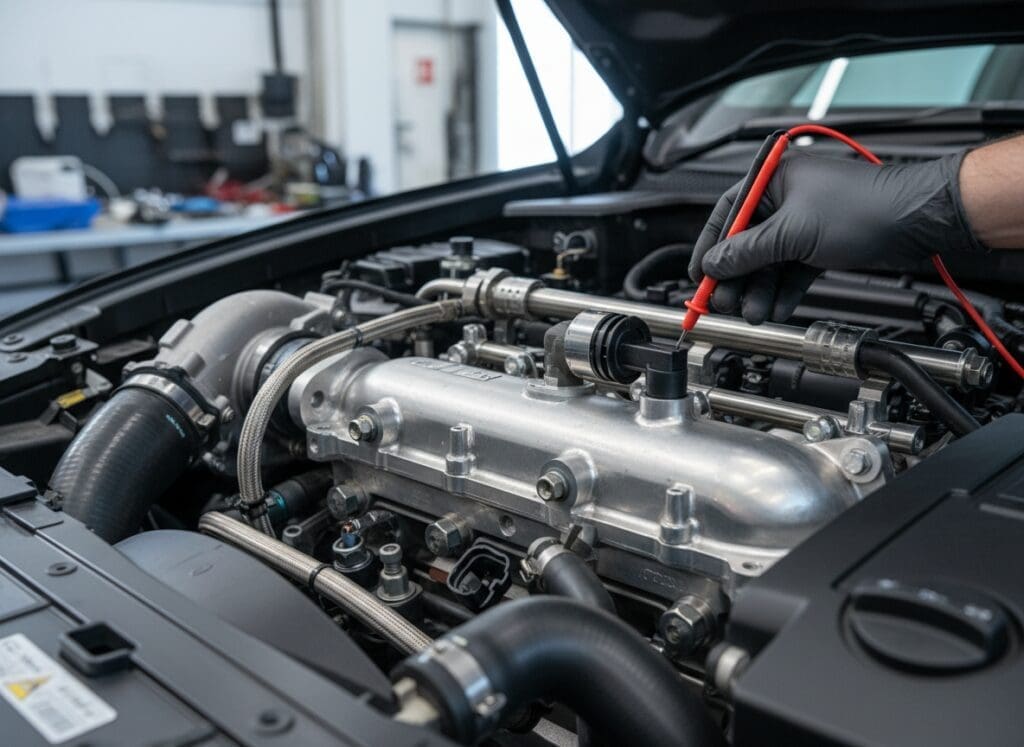
- Inspect the wiring harness — check for visible damage, corrosion, or chafing along the NOx sensor wiring, particularly near heat sources at the exhaust.
- Test the NOx sensor circuit voltage — check for correct supply voltage and signal at the sensor connector. A missing supply voltage points to the wiring or module, not the sensor itself.
- Check for AdBlue module faults — if the AdBlue dosing module is flagging faults, resolve those first before replacing the NOx sensor.
- Test with a known-good NOx sensor — if the circuit checks out, swapping the sensor confirms or eliminates the sensor as the cause.
How U029D Is Fixed
Once the root cause has been identified, the fix is usually straightforward:
| Root Cause | Fix | Typical Outcome |
|---|---|---|
| Failed NOx sensor | Replace NOx sensor | Code clears, emissions restored |
| Wiring damage | Repair or replace wiring harness | Communication restored |
| Failed AdBlue module | Replace or recondition AdBlue pump/module | System fully restored |
| ECU software issue | ECU software update or reset | False codes cleared |
| Contaminated AdBlue | Flush and refill AdBlue, then replace damaged sensor | System restored, sensor damage addressed |
After the repair, the fault codes must be cleared using diagnostic software and the vehicle should be driven through a full drive cycle to confirm the system is functioning correctly and no new faults are logged.
What About AdBlue Deletion as an Option?
Some vehicle owners ask about AdBlue deletion or NOx system removal as an alternative to repair. This involves remapping the ECU to disable AdBlue and NOx monitoring, removing the need for AdBlue fluid and the associated system components.
At Pro Remapping, we can carry out AdBlue delete work, but we’re always clear about what it involves. Vehicles with AdBlue deleted will not meet Euro 6 emissions standards and cannot legally be used on public roads in the UK. This type of work is carried out for off-road, agricultural, motorsport, or export use only.
For vehicles used on the road, repairing the NOx system is the correct approach. We can help you understand your options and give you an honest assessment of repair costs versus the alternatives.
Frequently Asked Questions
- Can I drive with a U029D fault code?
- In the early stages, many vehicles will drive normally with U029D active. However, the fault will likely worsen over time, and some vehicles progress to limp mode or engine start restrictions if left unresolved. Get it diagnosed as soon as possible.
- Will U029D cause an MOT failure?
- Yes. U029D and related NOx faults indicate the emissions control system is not functioning correctly. Vehicles presenting for MOT with active emissions-related fault codes will typically fail on emissions performance.
- Is U029D the same as a NOx sensor failure?
- Not always. U029D means communication with the NOx sensor module has been lost, but this could be due to a wiring fault, failed module, or power supply issue — not necessarily a sensor failure. Proper diagnostics are needed to confirm the actual cause.
- How much does it cost to fix U029D?
- Cost depends on the root cause. A simple wiring repair may be relatively inexpensive, while a NOx sensor replacement or AdBlue module repair typically costs more. Contact us for a diagnostic appointment and we’ll give you an accurate quote after assessment.
- Does Pro Remapping cover my vehicle type?
- We work on a wide range of diesel cars and commercial vehicles affected by U029D, including VW Group, Mercedes, Ford, and Stellantis vehicles. Contact us to confirm coverage for your specific make and model.
U029D Fault on Your Vehicle?
Don’t wait for an engine start restriction. Book a diagnostic session at Pro Remapping in Stoke-on-Trent and we’ll identify the exact cause and cost before any work begins.
Pro Remapping — 201 King Street, Fenton, Stoke-on-Trent, ST4 3ER. Serving Stoke-on-Trent, Staffordshire, Newcastle-under-Lyme, Congleton, Leek, Stafford, and Uttoxeter.


